

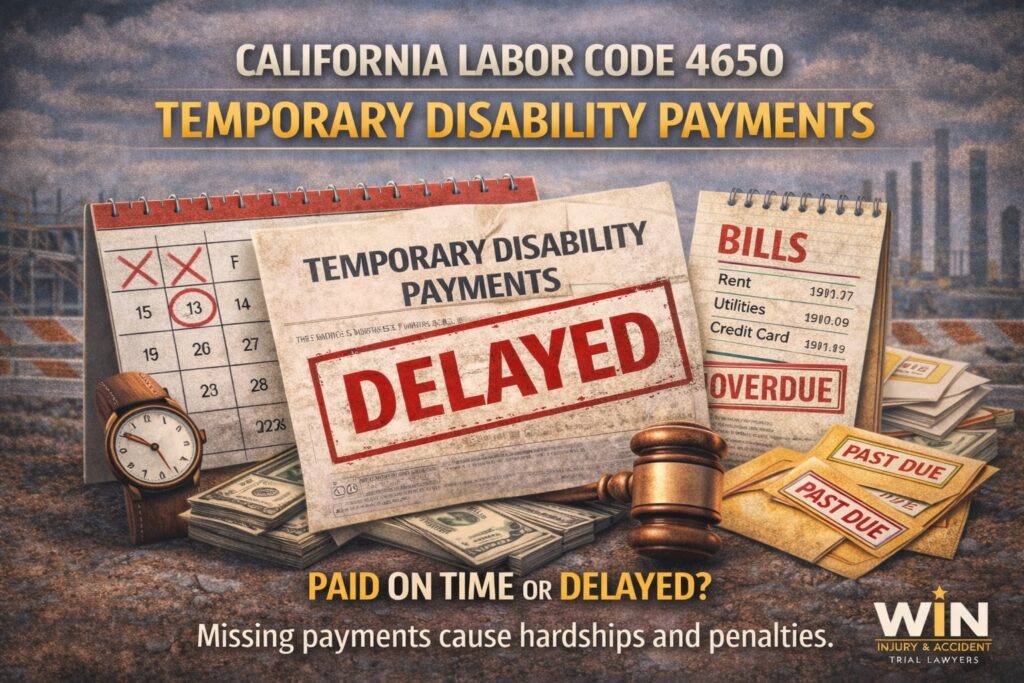
After a work injury, the first question most injured workers ask is simple:
“How am I supposed to pay my bills if I can’t work?”
California Labor Code § 4650 governs temporary disability (TD) payments — the wage-replacement benefits designed to keep injured workers financially afloat while they recover.
Unfortunately, TD payments are also one of the most delayed and mishandled benefits in the workers’ compensation system.
This guide explains what TD payments are, when they must start, how much you should receive, and what happens when insurance companies fail to pay on time.
What Are Temporary Disability Payments?
Temporary disability payments replace lost wages when a work injury prevents you from working or limits your ability to earn.
TD benefits apply when:
- A doctor takes you completely off work, or
- You are placed on work restrictions your employer cannot accommodate
Temporary disability continues until one of several legal endpoints is reached, not just until the insurer decides to stop paying.
What Labor Code § 4650 Requires
Labor Code § 4650 imposes strict obligations on employers and insurance carriers.
Key requirements include:
- TD payments must begin promptly
- Payments must be made every two weeks
- Payments must continue while disability exists
- Late payments trigger automatic penalties
This statute is designed to prevent insurers from using delay as leverage.
When Do Temporary Disability Payments Start?
TD payments must begin within 14 days after the employer has knowledge of the injury and disability.
If the employer or insurer delays beyond that point without justification, penalties may apply.
How Much Are Temporary Disability Payments?
In most cases, temporary disability payments are:
- Two-thirds (⅔) of your average weekly wages
- Subject to minimum and maximum rates set by law
- Tax-free
Your actual amount depends on:
- Your earnings before the injury
- Whether you worked full-time, part-time, or variable hours
- The date of injury (which determines the applicable rate cap)
Common Temporary Disability Payment Problems
Despite clear rules, we frequently see insurers:
- Delay the first TD check
- Stop payments without medical justification
- Miscalculate average weekly wages
- Ignore work restrictions
- Claim work is “available” when it is not
- Fail to pay penalties automatically
These issues are rarely accidental.
When Can Temporary Disability Payments Stop?
Temporary disability does not last forever, but it also cannot be stopped arbitrarily.
TD payments typically end when:
- You return to work
- Your doctor releases you to full duty
- Your condition reaches maximum medical improvement (MMI)
- You hit the statutory cap on TD duration
Stopping TD without a valid medical or legal basis is improper.
Penalties for Late or Unpaid TD Benefits
Labor Code § 4650 includes built-in consequences for delay.
If TD payments are late or unreasonably delayed, the insurer may owe:
- Automatic penalty increases
- Interest on unpaid amounts
- Additional litigation exposure
In some cases, repeated delay can support arguments that the insurer is acting outside statutory protections.
Temporary Disability vs. Permanent Disability
Temporary disability is not the same as permanent disability.
- Temporary disability pays wages while you are healing
- Permanent disability compensates long-term impairment after recovery
Ending TD does not mean your case is over.
Why Temporary Disability Drives Case Value
TD payments affect:
- Financial stability during recovery
- Pressure to settle early
- Ability to obtain proper medical care
- Overall leverage in the case
When TD is delayed or denied, injured workers are often pushed into unfair settlements.
What Injured Workers Should Do If TD Payments Are Delayed
If your TD payments are late, stopped, or missing:
- Keep copies of all medical work-status notes
- Track every payment date and amount
- Demand written explanations for delays
- Do not assume silence means denial is valid
- Speak with a workers’ compensation attorney early
TD issues tend to compound if not addressed quickly.
The Bottom Line
Labor Code § 4650 exists to protect injured workers from financial freefall after a work injury.
Temporary disability payments are not optional, not discretionary, and not a favor — they are a legal obligation.
When insurers forget that, the law provides remedies.
Workers’ Comp vs. Personal Injury: Key Differences
| Workers’ Comp | Personal Injury |
|---|---|
| No fault required | Fault must be proven |
| Limited benefits | Full damages available |
| No pain & suffering | Pain & suffering allowed |
| No jury | Jury trial available |
Exclusivity determines which path—or both—are available.
Get Help From WIN Injury & Accident Trial Lawyers
Why Legal Representation Matters
Insurance companies often undervalue pain and suffering—offering minimal settlements that ignore your daily struggles. A skilled attorney can:
- Present powerful evidence of your emotional and physical suffering
- Retain expert witnesses to quantify your losses
- Use verdict data to justify higher multipliers or per diem rates
- Argue your case persuasively before a jury
At WIN Trial Lawyers, our team fights to ensure that your recovery reflects the full extent of your suffering—not just your bills.

At WIN Trial Lawyers, we know how personal injury claims can be can be. Victims often face mounting medical bills, lost wages, and emotional trauma. Our team has successfully taken on insurance companies and third parties, recovering millions for injured clients.
If you or a loved one has been injured in an accident, don’t leave your future in the hands of the insurance company. You need experienced trial lawyers who know how to prove liability and fight for maximum compensation.
If you or a loved one has been injured, don’t face this alone. The sooner you act, the stronger your case will be.
🔗 Related Posts:
Frequently Asked Questions – Temporary Disability Payments (LC § 4650)
What are temporary disability (TD) payments?
Temporary disability payments are wage-replacement benefits paid to injured workers who cannot work, or cannot earn their usual wages, due to a work-related injury.
When do temporary disability payments start?
TD payments must generally begin within 14 days after the employer knows about the injury and the resulting disability.
How often are TD payments paid?
Temporary disability payments are paid every two weeks as long as disability continues and no legal basis exists to stop them.
How much will I receive in temporary disability?
Most injured workers receive:
- Two-thirds (⅔) of their average weekly wages
- Subject to state-set minimum and maximum limits
- Tax-free
The exact amount depends on your earnings and date of injury.
Are temporary disability payments taxable?
No. Temporary disability payments are not taxable income under California workers’ compensation law.
What if my TD payments are late?
Late or delayed payments may trigger:
- Automatic penalties
- Interest on unpaid benefits
- Additional legal consequences for the insurer
Delays are not allowed without valid justification.
Can the insurance company stop my TD payments?
TD payments may only stop for valid reasons, such as:
- You return to work
- Your doctor releases you to full duty
- You reach maximum medical improvement (MMI)
- You reach the legal cap on TD benefits
Payments cannot be stopped arbitrarily.
What is Maximum Medical Improvement (MMI)?
MMI means your condition has stabilized and is unlikely to significantly improve with further treatment. Reaching MMI usually ends temporary disability but does not end the case.
What if my employer claims work is available?
If your employer claims modified or alternative work is available, it must:
- Match your medical restrictions
- Be offered in good faith
Fake or unsuitable job offers do not justify stopping TD.
Can TD payments stop even if I still need medical care?
Yes. TD focuses on wage loss, not treatment. Medical care under Labor Code § 4600 may continue even after TD ends.
What if my TD payments are miscalculated?
Miscalculations are common, especially with overtime, bonuses, or variable schedules. Underpayment may entitle you to back pay and penalties.
Is there a limit on how long I can receive TD?
Yes. California law imposes time limits on TD benefits, depending on the type and severity of injury. Some serious injuries qualify for extended benefits.
What if my TD checks suddenly stop with no explanation?
Unexplained stoppages are often improper. Insurers must provide a legal and medical basis for stopping payments.
Can I work part-time and still receive TD?
Possibly. If you return to modified or part-time work and earn less than your pre-injury wages, you may receive temporary partial disability benefits.
What is the difference between temporary disability and permanent disability?
- Temporary disability pays wages while you are healing
- Permanent disability compensates long-term impairment after recovery
Ending TD does not mean your case is finished.
Can TD payment problems affect my settlement?
Yes. TD disputes often:
- Increase case value
- Strengthen settlement leverage
- Expose insurer misconduct
Improper TD handling can significantly change outcomes.
What should I do if my TD payments are delayed or stopped?
You should:
- Keep all medical work-status reports
- Track every payment date and amount
- Request written explanations
- Avoid assuming the insurer is correct
- Speak with a workers’ compensation attorney promptly
Why do insurers delay TD payments?
Delays are often used as leverage to:
- Force early settlements
- Pressure injured workers financially
- Limit long-term exposure
Labor Code § 4650 exists to prevent this behavior.