

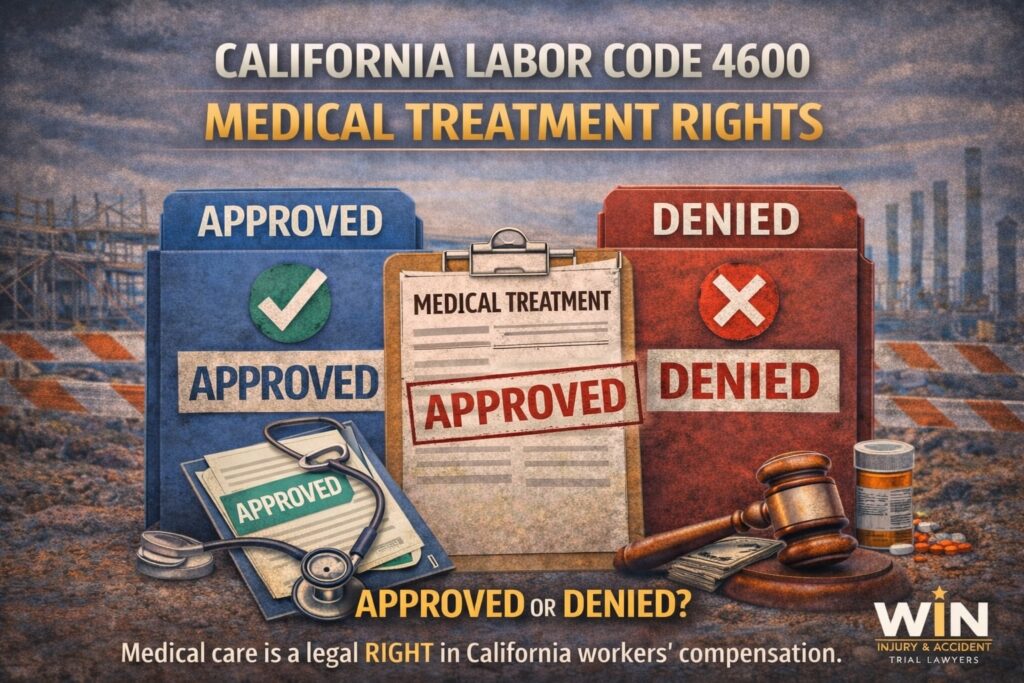
When you’re injured at work, medical treatment is not a favor — it’s a legal right.
California Labor Code 4600 requires employers and workers’ compensation insurance carriers to provide and pay for all medical treatment that is reasonably required to cure or relieve the effects of a work-related injury.
Yet in practice, this is one of the most frequently violated rights in the entire workers’ compensation system.
This guide explains what LC § 4600 guarantees, how insurers delay or deny care, and what injured workers can do when treatment is blocked.
What Labor Code 4600 Requires
Under Labor Code 4600, employers must provide:
- Medical treatment that is reasonably necessary
- Care that is designed to cure or relieve the effects of the injury
- Treatment recommended by a qualified medical provider
- Ongoing care — not just emergency or initial treatment
This includes, when medically justified:
- Doctor visits
- Diagnostic testing (MRIs, CT scans, X-rays)
- Surgery
- Physical therapy
- Medications
- Mental health treatment
- Medical equipment and assistive devices
The obligation begins as soon as the employer has notice of the injury.
“Reasonably Required” — What That Really Means
Insurance companies often argue that treatment isn’t “reasonably required.”
In reality, this standard is medical — not financial.
Treatment is reasonably required when it:
- Reduces pain
- Improves function
- Prevents deterioration
- Helps the injured worker return to work or daily activities
- Stabilizes a chronic condition caused by the injury
Treatment does not have to fully cure the injury to be required under the law.
How Insurers Delay or Deny Medical Care
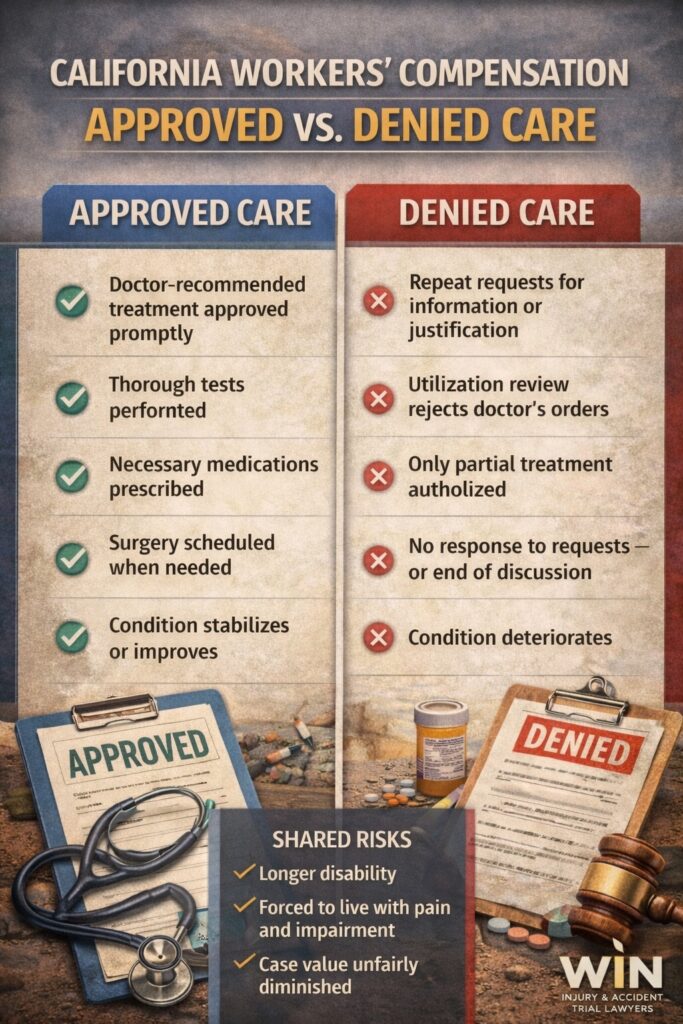
Despite LC § 4600, delays are common. We regularly see:
- Utilization Review (UR) denials
- Requests labeled “experimental” without real justification
- Endless requests for additional documentation
- Partial approvals that delay meaningful care
- Silence — no response at all
Delays often cause injuries to worsen, extend disability periods, and pressure injured workers into premature settlements.
Utilization Review Does NOT Eliminate Your Rights
Insurers rely heavily on Utilization Review, but UR is not absolute.
Key points injured workers should know:
- UR decisions must be timely
- UR doctors do not examine you
- UR must follow medical guidelines — not cost targets
- Improper UR denials can be challenged
When UR is abused, injured workers can request independent medical review or escalate disputes through litigation.
Choice of Doctor Matters
Medical rights under LC § 4600 are heavily impacted by who controls treatment.
Depending on timing and circumstances:
- Employers may direct initial care
- Injured workers may later choose their own doctor
- Medical Provider Networks (MPNs) impose rules — but not absolute control
A bad treating doctor can stall care just as effectively as a denial.
What Happens When Medical Care Is Wrongfully Denied
When treatment is improperly delayed or denied, consequences can include:
- Worsened injuries
- Permanent impairment that could have been avoided
- Increased disability exposure for the employer
- Penalties and litigation consequences
Repeated or unreasonable denials can also support arguments that an insurer is acting in bad faith or outside statutory protections.
Medical Treatment Is the Backbone of Your Case
Medical care doesn’t just affect your health — it determines:
- Disability status
- Work restrictions
- Permanent impairment ratings
- Settlement value
- Future medical rights
A workers’ compensation case without proper medical treatment is never a fair case.
What Injured Workers Should Do If Treatment Is Delayed
If your medical care is being delayed or denied:
- Document all symptoms and limitations
- Follow up on every pending authorization
- Request written denial explanations
- Do not assume “no response” means “no rights”
- Speak with a workers’ compensation attorney early
Waiting rarely fixes medical delays — pressure does.
Why LC 4600 Matters So Much
Labor Code 4600 is not just about doctor visits.
It is the legal foundation that ensures injured workers are treated as patients — not cost centers.
When insurers forget that, the law provides remedies.
Workers’ Comp vs. Personal Injury: Key Differences
| Workers’ Comp | Personal Injury |
|---|---|
| No fault required | Fault must be proven |
| Limited benefits | Full damages available |
| No pain & suffering | Pain & suffering allowed |
| No jury | Jury trial available |
Exclusivity determines which path—or both—are available.
Get Help From WIN Injury & Accident Trial Lawyers
Why Legal Representation Matters
Insurance companies often undervalue pain and suffering—offering minimal settlements that ignore your daily struggles. A skilled attorney can:
- Present powerful evidence of your emotional and physical suffering
- Retain expert witnesses to quantify your losses
- Use verdict data to justify higher multipliers or per diem rates
- Argue your case persuasively before a jury
At WIN Trial Lawyers, our team fights to ensure that your recovery reflects the full extent of your suffering—not just your bills.

At WIN Trial Lawyers, we know how personal injury claims can be can be. Victims often face mounting medical bills, lost wages, and emotional trauma. Our team has successfully taken on insurance companies and third parties, recovering millions for injured clients.
If you or a loved one has been injured in an accident, don’t leave your future in the hands of the insurance company. You need experienced trial lawyers who know how to prove liability and fight for maximum compensation.
If you or a loved one has been injured, don’t face this alone. The sooner you act, the stronger your case will be.
🔗 Related Posts:
Frequently Asked Questions About Medical Treatment Rights (LC § 4600)
What does Labor Code § 4600 guarantee?
Labor Code § 4600 guarantees injured workers the right to all medical treatment reasonably required to cure or relieve the effects of a work-related injury. This includes ongoing care — not just emergency treatment.
Does workers’ comp have to pay for all medical treatment?
Workers’ compensation must pay for reasonable and necessary treatment related to the work injury. The insurer does not get to deny care simply because it is expensive or long-term.
What types of medical treatment are covered?
Covered treatment may include:
- Doctor visits and specialist care
- Surgery
- Physical therapy
- Diagnostic testing (MRI, CT scans, X-rays)
- Prescription medications
- Mental health treatment
- Medical equipment and assistive devices
What does “reasonably required” mean?
“Reasonably required” means treatment that:
- Reduces pain
- Improves function
- Prevents worsening of the injury
- Helps stabilize the condition
Treatment does not need to fully cure the injury to be covered.
Can workers’ comp deny treatment through Utilization Review (UR)?
Insurers may use Utilization Review, but UR does not eliminate your rights. UR decisions must be timely, medically supported, and compliant with legal guidelines. Improper denials can be challenged.
What if my treatment request is delayed?
Delays are common and often unlawful. If treatment is delayed:
- Your injury may worsen
- Disability may increase
- The insurer may face legal consequences
Delays should be challenged — silence is not a valid denial.
Can I choose my own doctor?
It depends on timing and whether your employer uses a Medical Provider Network (MPN). In many cases, injured workers can eventually change doctors, especially if care is inadequate.
What if my doctor recommends surgery but insurance denies it?
Surgery can be denied only if the insurer proves it is not medically necessary. Many surgical denials are overturned when properly challenged.
Does workers’ comp have to cover future medical care?
Yes. If future medical treatment is reasonably necessary due to the work injury, it must be provided unless validly resolved through settlement.
Can lack of treatment affect my settlement?
Absolutely. Medical treatment drives:
- Disability ratings
- Permanent impairment
- Settlement value
Cases with delayed or denied care often settle for less — unfairly.
What if treatment delays make my injury worse?
If delays aggravate your injury, that worsening may become compensable. Insurers are not protected when their actions cause additional harm.
Can I pay out of pocket for treatment?
You can, but you should be cautious. Some out-of-pocket treatment may be reimbursable, but insurers often dispute it. Always document approvals and denials first.
Does mental health treatment count under LC § 4600?
Yes. When psychological conditions stem from a physical work injury or are otherwise compensable, mental health treatment may be required.
What if the insurance company says treatment is “experimental”?
Labeling treatment as “experimental” does not automatically justify denial. The insurer must support that claim with valid medical evidence.
Can repeated denials lead to penalties?
Yes. Repeated unreasonable denials or delays may expose insurers and employers to penalties, increased liability, and litigation consequences.
Should I get a lawyer if medical care is being denied?
If treatment is delayed, denied, or ignored, speaking with a workers’ compensation attorney early can protect both your health and your case value.