

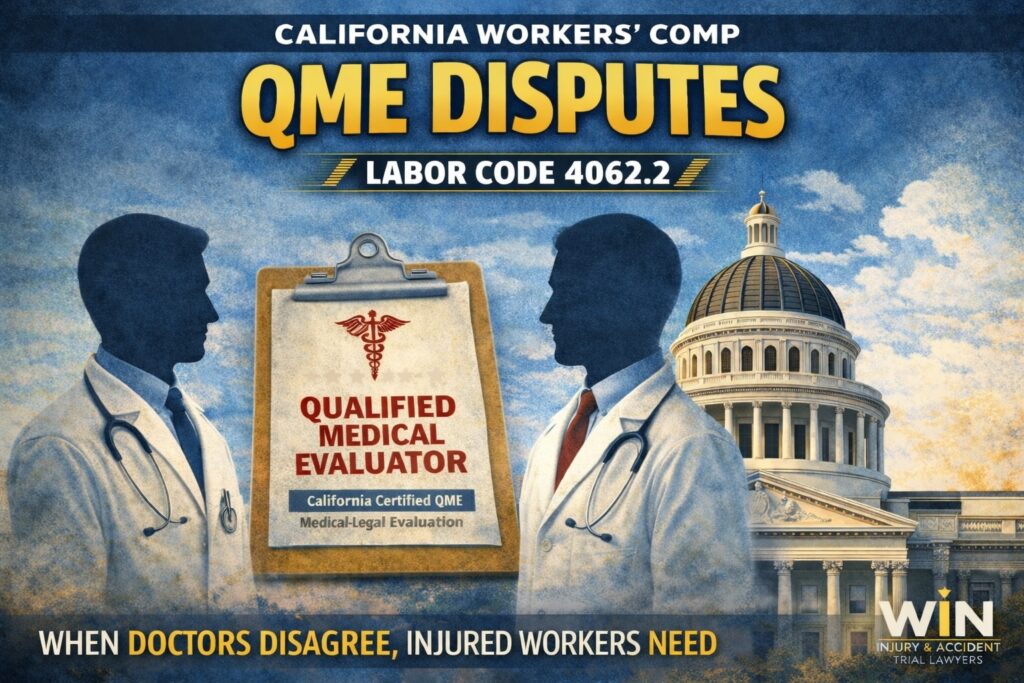
When a workers’ compensation claim is disputed in California, medical opinions often determine everything — whether your injury is work-related, how serious it is, and what benefits you receive.
Labor Code 4062.2 governs how disputes over medical issues are resolved when an injured worker is represented by an attorney. It sets the rules for selecting a Qualified Medical Evaluator (QME) and ensures neither side controls the process unfairly.
Understanding this statute is critical, because a QME report can make or break a workers’ compensation case.
What the Text of the Statute Says:
California Labor Code 4062.2:
(a) Whenever a comprehensive medical evaluation is required to resolve any dispute arising out of an injury or a claimed injury occurring on or after January 1, 2005, and the employee is represented by an attorney, the evaluation shall be obtained only as provided in this section.
(b) No earlier than the first working day that is at least 10 days after the date of mailing of a request for a medical evaluation pursuant to Section 4060 or the first working day that is at least 10 days after the date of mailing of an objection pursuant to Sections 4061 or 4062, either party may request the assignment of a three-member panel of qualified medical evaluators to conduct a comprehensive medical evaluation. The party submitting the request shall designate the specialty of the medical evaluator, the specialty of the medical evaluator requested by the other party if it has been made known to the party submitting the request, and the specialty of the treating physician. The party submitting the request form shall serve a copy of the request form on the other party.
(c) Within 10 days of assignment of the panel by the administrative director, each party may strike one name from the panel. The remaining qualified medical evaluator shall serve as the medical evaluator. If a party fails to exercise the right to strike a name from the panel within 10 days of assignment of the panel by the administrative director, the other party may select any physician who remains on the panel to serve as the medical evaluator. The administrative director may prescribe the form, the manner, or both, by which the parties shall conduct the selection process.
(d) The represented employee shall be responsible for arranging the appointment for the examination, but upon his or her failure to inform the employer of the appointment within 10 days after the medical evaluator has been selected, the employer may arrange the appointment and notify the employee of the arrangements. The employee shall not unreasonably refuse to participate in the evaluation.
(e) If an employee has received a comprehensive medical-legal evaluation under this section, and he or she later ceases to be represented, he or she shall not be entitled to an additional evaluation.
(f) The parties may agree to an agreed medical evaluator at any time, except as to issues subject to the independent medical review process established pursuant to Section 4610.5. A panel shall not be requested pursuant to subdivision (b) on any issue that has been agreed to be submitted to or has been submitted to an agreed medical evaluator unless the agreement has been canceled by mutual written consent.
(Amended by Stats. 2012, Ch. 363, Sec. 29. (SB 863) Effective January 1, 2013.)
What Is a QME?
A Qualified Medical Evaluator (QME) is a state-certified doctor who evaluates injured workers when there is a disagreement between:
- The injured worker
- The employer
- The insurance company
QMEs issue formal medical-legal opinions on issues like:
- Whether the injury is work-related
- The extent of disability
- Need for ongoing medical treatment
- Permanent impairment ratings
- Work restrictions and future care
When Labor Code 4062.2 Applies
Labor Code 4062.2 applies only when the injured worker is represented by an attorney.
If you are unrepresented, a different statute governs QME selection.
Under 4062.2, the law assumes both sides have legal counsel and must follow a structured, time-sensitive process to resolve medical disputes fairly.
How the QME Selection Process Works Under 4062.2
Step 1: Medical Dispute Arises
A dispute may involve:
- Injury causation
- Temporary or permanent disability
- Work restrictions
- Need for surgery or treatment
- Future medical care
Once a dispute exists, either side may initiate the QME process.
Step 2: Attempt to Agree on a QME
The parties first have 10 days to attempt to agree on a single QME.
If both sides agree, that doctor conducts the evaluation.
If no agreement is reached, the process moves forward automatically.
Step 3: Request a QME Panel
If the parties cannot agree, a QME panel is requested from the Division of Workers’ Compensation.
The panel consists of three doctors in a specific medical specialty related to the dispute.
Step 4: Striking Process
Each side may strike one doctor from the panel.
- The injured worker strikes one
- The employer/insurer strikes one
The remaining doctor becomes the panel QME.
This process is designed to prevent either side from stacking the deck.
Why Labor Code 4062.2 Matters So Much
A QME report often controls:
- Whether your claim is accepted or denied
- How much temporary disability you receive
- Whether you qualify for permanent disability
- The value of your settlement
Insurance companies know this — which is why they aggressively litigate QME disputes.
Labor Code 4062.2 exists to prevent manipulation of the medical-legal process and to keep disputes focused on evidence, not gamesmanship.
Common Problems in QME Disputes
Even with clear rules, disputes often arise over:
- Missed deadlines
- Improper panel requests
- Wrong medical specialty
- Unilateral scheduling of exams
- Attempts to replace unfavorable QMEs
- Defective or biased medical reports
These issues can significantly delay benefits and settlements.
What Happens If the QME Process Is Violated?
When a party violates Labor Code 4062.2, consequences may include:
- Loss of the right to select or strike a QME
- Replacement of the QME
- Exclusion of the medical report
- Sanctions or penalties
- Significant leverage shifts in the case
Strict compliance with timelines and procedures is critical.
How QME Disputes Affect Your Case Value
A strong, well-supported QME report can:
- Establish permanent disability
- Support future medical care
- Increase settlement value
- Strengthen leverage at mediation
A weak or biased report can do the opposite.
This is why experienced workers’ compensation counsel is essential in navigating QME disputes.
Why Injured Workers Should Not Handle QME Disputes Alone
QME disputes are procedural traps for the unprepared.
Small mistakes — even missing a deadline by one day — can permanently affect your rights.
At WIN Injury & Accident Trial Lawyers, we focus on protecting injured workers at every stage of the QME process, ensuring:
- Proper panel selection
- Correct specialty designation
- Strategic striking decisions
- Complete medical record submissions
- Aggressive challenges to flawed reports
Get Help With a QME Dispute
If your workers’ compensation case involves a disputed medical issue, Labor Code 4062.2 will likely control what happens next.
Before you attend a QME exam or agree to a doctor, speak with an experienced workers’ compensation attorney.
The medical opinion you get may determine the outcome of your entire case.
Workers’ Comp vs. Personal Injury: Key Differences
| Workers’ Comp | Personal Injury |
|---|---|
| No fault required | Fault must be proven |
| Limited benefits | Full damages available |
| No pain & suffering | Pain & suffering allowed |
| No jury | Jury trial available |
Exclusivity determines which path—or both—are available.
Get Help From WIN Injury & Accident Trial Lawyers
Why Legal Representation Matters
Insurance companies often undervalue pain and suffering—offering minimal settlements that ignore your daily struggles. A skilled attorney can:
- Present powerful evidence of your emotional and physical suffering
- Retain expert witnesses to quantify your losses
- Use verdict data to justify higher multipliers or per diem rates
- Argue your case persuasively before a jury
At WIN Trial Lawyers, our team fights to ensure that your recovery reflects the full extent of your suffering—not just your bills.

At WIN Trial Lawyers, we know how personal injury claims can be can be. Victims often face mounting medical bills, lost wages, and emotional trauma. Our team has successfully taken on insurance companies and third parties, recovering millions for injured clients.
If you or a loved one has been injured in an accident, don’t leave your future in the hands of the insurance company. You need experienced trial lawyers who know how to prove liability and fight for maximum compensation.
If you or a loved one has been injured, don’t face this alone. The sooner you act, the stronger your case will be.
🔗 Related Posts:
Frequently Asked Questions About Labor Code 4062.2 (QME Disputes)
What is Labor Code 4062.2?
Labor Code 4062.2 governs how medical disputes are resolved in California workers’ compensation cases when the injured worker has an attorney. It sets the rules for selecting a Qualified Medical Evaluator (QME) and resolving disagreements over medical issues.
When does Labor Code 4062.2 apply?
It applies only if the injured worker is represented by an attorney.
If you are not represented, a different QME statute applies.
What types of disputes trigger Labor Code 4062.2?
Common disputes include:
- Whether the injury is work-related
- The extent of temporary or permanent disability
- Need for surgery or medical treatment
- Work restrictions or ability to return to work
- Future medical care
What is a QME?
A Qualified Medical Evaluator (QME) is a state-certified doctor who issues medical-legal opinions in disputed workers’ compensation cases. Their report often determines benefits and case value.
Can the parties agree on a QME?
Yes. Under Labor Code 4062.2, the parties have 10 days to agree on a single QME. If they agree, that doctor performs the evaluation.
What happens if the parties do not agree on a QME?
If no agreement is reached, a QME panel of three doctors is requested from the Division of Workers’ Compensation.
How is the final QME selected from a panel?
Each side may strike one doctor from the panel.
The remaining doctor becomes the panel QME.
Who gets to strike first?
The order of striking depends on who requested the panel and whether deadlines were met. Missing a deadline can result in losing the right to strike.
Can the insurance company control the QME process?
No. Labor Code 4062.2 is designed to prevent either side from controlling QME selection. However, insurers often attempt to gain advantage through procedural tactics.
What happens if deadlines under 4062.2 are missed?
Missing deadlines can result in:
- Loss of the right to strike a doctor
- Loss of control over panel selection
- Waiver of objections
- Significant strategic disadvantage
Can a QME be replaced?
In limited circumstances, such as:
- Conflict of interest
- Bias or improper conduct
- Procedural violations
- Disqualification under WCAB rules
Replacing a QME is difficult and highly technical.
Can I refuse to attend a QME exam?
Refusing to attend a properly scheduled QME exam can result in:
- Suspension of benefits
- Adverse rulings
- Dismissal of disputed issues
Always speak with an attorney before missing or rescheduling a QME.
What should I bring to a QME exam?
Typically:
- Photo ID
- Relevant medical records
- Job description
- A clear and accurate history of your injury
Your attorney usually controls what records are submitted to the QME.
Can the QME decide my case?
Not directly, but QME opinions often carry enormous weight and are relied upon by judges to decide disputed issues.
Is a QME the same as an AME?
No.
- A QME is selected from a state panel.
- An AME (Agreed Medical Evaluator) is jointly chosen by both parties without a panel.
AMEs are less common but often more influential.
Can I challenge a QME report?
Yes. QME reports can be challenged if they are:
- Incomplete
- Not medically substantiated
- Legally defective
- Based on incorrect facts
Challenges must follow strict procedural rules.
Can QME disputes delay my case?
Yes. QME disputes are one of the most common causes of delay in workers’ compensation cases.
Does a QME affect settlement value?
Absolutely. A strong QME report can significantly increase settlement value. A weak or biased report can drastically reduce it.
Should I have a lawyer for a QME dispute?
Yes. QME disputes involve strict deadlines, procedural traps, and long-term consequences. Mistakes are often irreversible.
Can Labor Code 4062.2 violations result in penalties?
Yes. Violations can lead to:
- Exclusion of medical evidence
- Loss of procedural rights
- Sanctions
- Adverse rulings by the WCAB
What if the insurance company schedules the QME improperly?
Improper scheduling may invalidate the exam or result in loss of the insurer’s rights — but only if properly challenged.
How long does the QME process take?
It often takes several months from panel request to final report, and longer if disputes arise.
What should I do if my case involves a QME dispute?
Do not proceed blindly. Speak with a workers’ compensation attorney before agreeing to a QME, attending an exam, or striking a doctor.