

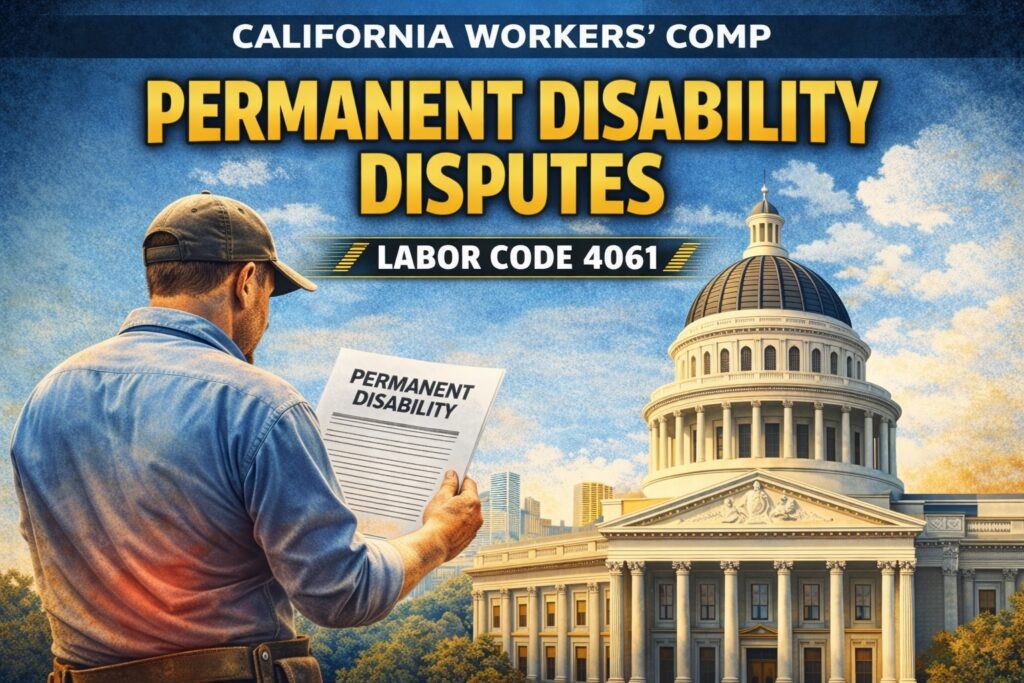
When a workers’ compensation case reaches the point where an injured worker’s condition has stabilized, a new question arises: What level of permanent disability does the worker have—and how much should they be paid?
California Labor Code 4061 governs what happens when there is a dispute about permanent disability (PD). These disputes are common, highly technical, and often determine the final value of a workers’ compensation case.
Understanding how PD disputes work under Labor Code 4061 can make the difference between accepting an unfair rating and securing the benefits you’re entitled to.
What Is Labor Code 4061?
Labor Code 4061 applies after an injured worker’s condition has reached permanent and stationary (P&S) status or maximum medical improvement (MMI), and the employer or insurance company believes:
- No permanent disability exists, or
- Permanent disability exists, but disagrees with the amount.
The statute sets out how disputes over permanent disability must be handled, including notice requirements and the right to seek a medical-legal evaluation.
When Does a PD Dispute Arise?
A permanent disability dispute usually arises after the claims administrator issues one of the following:
- A Notice of Permanent Disability stating no PD is owed
- A notice stating PD exists but at a specific percentage
- A Notice of Offer of Permanent Disability Payments based on an insurance-selected rating
If the injured worker disagrees with the PD determination, Labor Code 4061 controls the next steps.
How Labor Code 4061 Disputes Work
Step 1: The Notice Requirement
Under Labor Code 4061, the insurance company must issue a written notice explaining its PD determination. This notice must inform the injured worker of their right to dispute the PD rating.
If the notice is defective or misleading, it can impact the worker’s rights and deadlines.
Step 2: Medical-Legal Evaluation (QME or AME)
If the injured worker disputes the PD finding, the disagreement is resolved through a medical-legal process, typically involving:
- A Qualified Medical Evaluator (QME), or
- An Agreed Medical Evaluator (AME) if both sides agree
The evaluator examines the worker and issues a report addressing:
- Permanent impairment
- Apportionment
- Work restrictions
- Future medical needs
That medical opinion is critical—it often becomes the foundation for the PD rating.
Deadlines Matter
Labor Code 4061 disputes are subject to strict timelines. Missing a deadline can result in:
- Loss of the right to challenge the PD rating
- Acceptance of an undervalued rating
- Reduced permanent disability payments
This is one reason PD disputes should never be handled casually.
Why PD Disputes Are So Important
Permanent disability benefits are paid over time and are calculated based on:
- The PD percentage
- The worker’s age
- The worker’s occupation
- The date of injury
Even a small change in the PD percentage can mean thousands—or tens of thousands—of dollars in additional benefits.
Insurance companies have a financial incentive to minimize PD ratings, which is why disputes under Labor Code 4061 are so common.
Common Issues in PD Disputes
PD disputes often involve disagreements over:
- Whether permanent disability exists at all
- The accuracy of impairment ratings
- Apportionment to non-industrial causes
- Functional limitations and work restrictions
- Future medical care
These issues frequently require experienced legal advocacy to challenge properly.
Common Mistakes Injured Workers Make
Without guidance, injured workers may:
- Accept an insurance-selected PD rating too quickly
- Miss deadlines to object
- Underestimate the long-term impact of PD
- Fail to challenge improper apportionment
Once PD is finalized, it can be very difficult to undo.
How WIN Injury & Accident Trial Lawyers Helps
At WIN Injury & Accident Trial Lawyers, we routinely handle permanent disability disputes under Labor Code 4061. We help injured workers by:
- Reviewing PD notices for compliance
- Challenging improper ratings
- Selecting and preparing for QME or AME evaluations
- Litigating disputes before the Workers’ Compensation Appeals Board
- Maximizing permanent disability benefits
Permanent disability is often the most valuable component of a workers’ comp case. It deserves careful handling.
Bottom Line
California Labor Code 4061 governs what happens when there is a disagreement about permanent disability. These disputes are technical, deadline-driven, and heavily influenced by medical evidence.
If you disagree with a PD determination—or are unsure whether it’s fair—speaking with an experienced workers’ compensation attorney can help protect your rights and your future benefits.
Workers’ Comp vs. Personal Injury: Key Differences
| Workers’ Comp | Personal Injury |
|---|---|
| No fault required | Fault must be proven |
| Limited benefits | Full damages available |
| No pain & suffering | Pain & suffering allowed |
| No jury | Jury trial available |
Exclusivity determines which path—or both—are available.
Get Help From WIN Injury & Accident Trial Lawyers
Why Legal Representation Matters
Insurance companies often undervalue pain and suffering—offering minimal settlements that ignore your daily struggles. A skilled attorney can:
- Present powerful evidence of your emotional and physical suffering
- Retain expert witnesses to quantify your losses
- Use verdict data to justify higher multipliers or per diem rates
- Argue your case persuasively before a jury
At WIN Trial Lawyers, our team fights to ensure that your recovery reflects the full extent of your suffering—not just your bills.

At WIN Trial Lawyers, we know how personal injury claims can be can be. Victims often face mounting medical bills, lost wages, and emotional trauma. Our team has successfully taken on insurance companies and third parties, recovering millions for injured clients.
If you or a loved one has been injured in an accident, don’t leave your future in the hands of the insurance company. You need experienced trial lawyers who know how to prove liability and fight for maximum compensation.
If you or a loved one has been injured, don’t face this alone. The sooner you act, the stronger your case will be.
🔗 Related Posts:
Frequently Asked Questions About Labor Code 4061 (Permanent Disability Disputes)
What is a permanent disability (PD) dispute?
A permanent disability dispute occurs when an injured worker disagrees with the insurance company’s determination that:
- No permanent disability exists, or
- The percentage of permanent disability is too low.
Labor Code 4061 governs how these disputes are handled.
When does Labor Code 4061 apply?
Labor Code 4061 applies after a worker’s condition becomes permanent and stationary (P&S) or reaches maximum medical improvement (MMI), and the insurance company issues a PD notice.
What triggers a PD dispute?
A dispute can be triggered when the claims administrator:
- Denies permanent disability altogether
- Assigns a PD percentage the worker disagrees with
- Issues a Notice of Permanent Disability Payments the worker believes is incorrect
Do I have to accept the insurance company’s PD rating?
No. You are not required to accept the insurer’s PD rating. If you disagree, Labor Code 4061 gives you the right to dispute it through the medical-legal process.
How do I dispute a permanent disability determination?
Most PD disputes are resolved through:
- A Qualified Medical Evaluator (QME), or
- An Agreed Medical Evaluator (AME) if both sides agree
The evaluator issues a report that forms the basis of the PD rating.
What is a QME and why does it matter?
A QME is a neutral doctor certified by the state to evaluate disputed workers’ comp issues. The QME’s opinions on impairment, apportionment, and work restrictions are often decisive in PD disputes.
What is an AME and how is it different?
An AME is a doctor chosen by agreement between the injured worker and the insurance company. AMEs are often used when both sides want to streamline the process and avoid multiple evaluations.
Are there deadlines to dispute PD under Labor Code 4061?
Yes. There are strict timelines for objecting to PD determinations and requesting medical-legal evaluations. Missing a deadline can result in losing the right to challenge the PD rating.
What happens if I miss a deadline?
Missing a deadline may mean:
- The PD rating becomes final
- You lose the ability to dispute the rating
- You receive less compensation than you’re entitled to
What factors affect my permanent disability rating?
PD ratings are based on:
- Medical impairment
- Work restrictions
- Age at the time of injury
- Occupation
- Apportionment to non-work causes
What is apportionment and why is it important?
Apportionment reduces PD benefits based on alleged non-industrial causes (such as prior injuries or degenerative conditions). Improper apportionment is one of the most common issues in PD disputes.
Can the insurance company say my disability is partly “non-industrial”?
They can try — but they must support it with substantial medical evidence. Unsupported or speculative apportionment can be challenged.
Does permanent disability mean I can never work again?
No. Permanent disability does not require total disability. Many workers with PD can continue working with restrictions or in modified roles.
How are permanent disability benefits paid?
PD benefits are typically paid:
- Weekly, based on your PD percentage
- At a statutory rate
- Over a fixed number of weeks
Higher PD ratings mean higher total benefits.
Can my PD rating increase after a dispute?
Yes. Many PD disputes result in higher ratings after proper medical evaluation and legal advocacy.
Can PD disputes affect future medical care?
Yes. PD evaluations often address future medical treatment, which can significantly impact your long-term care rights.
Can I settle my case while disputing PD?
Yes. Many cases resolve through settlement, including:
- Stipulations with Request for Award, or
- Compromise and Release
The PD rating plays a major role in settlement value.
What if the insurance doctor says I have no permanent disability?
That opinion can be disputed. Independent medical-legal evaluations often reach different conclusions.
Why do insurance companies fight PD ratings?
PD benefits are one of the most expensive parts of a workers’ compensation claim. Insurers have a financial incentive to minimize ratings.
Should I have a lawyer for a PD dispute?
While not required, PD disputes are highly technical. Legal representation can:
- Protect deadlines
- Challenge improper ratings
- Address apportionment
- Maximize benefits
Does WIN Injury & Accident Trial Lawyers handle PD disputes?
Yes. WIN Injury & Accident Trial Lawyers regularly represents injured workers in permanent disability disputes under Labor Code 4061 and fights to secure fair outcomes.
What should I do if I receive a PD notice I don’t agree with?
Do not ignore it. Speak with a workers’ compensation attorney as soon as possible to preserve your rights and evaluate your options.