
What Does Evidence Code § 352 Say?
California Evidence Code § 352 gives judges the authority to exclude evidence—even if it is relevant—when its negative impact outweighs its usefulness.
In plain English, the statute asks:
Will this evidence help the jury decide the case fairly, or will it distract, confuse, or unfairly prejudice them?
This rule is one of the most important safeguards in personal injury trials.
The Text of Evidence Code § 352
“The court in its discretion may exclude evidence if its probative value is substantially outweighed by the probability that its admission will
(a) necessitate undue consumption of time, or
(b) create substantial danger of undue prejudice, of confusing the issues, or of misleading the jury.”
Even relevant evidence does not automatically belong before a jury.
How Evidence Code § 352 Works in Personal Injury Cases
In personal injury and car accident cases, defendants frequently try to introduce evidence that sounds damaging but does little to prove fault, causation, or damages.
Evidence Code § 352 is the primary tool courts use to keep trials focused, fair, and fact-driven.
What Does “Undue Prejudice” Mean?
“Prejudice” does not mean evidence that hurts one side’s case.
It means evidence that appeals to emotion, bias, or improper reasoning, rather than logic.
Unduly prejudicial evidence may:
- Trigger anger, fear, or moral judgment
- Distract jurors from the real issues
- Encourage decisions based on character instead of conduct
Common ExaCommon Examples of Evidence Excluded Under § 352 in Injury Cases
Evidence Code § 352 is frequently used to prevent juries from being influenced by information that sounds damaging but does little to prove fault, causation, or damages. Below are common categories where courts step in to keep trials fair and focused.
Car & Truck Accident Cases
In auto and trucking cases, courts often exclude evidence that distracts from how the collision actually occurred. This commonly includes:
- Unrelated prior accidents or claims that have no bearing on the current crash
- Traffic tickets or violations unrelated to the incident at issue
- Evidence of unrelated criminal history, offered to imply bad character rather than fault
- Inflammatory or dramatic photographs that add emotion but little factual value
While this evidence may sound important, courts routinely find that it creates unfair prejudice without meaningfully advancing the jury’s understanding of liability.
Medical & Injury Evidence
Medical evidence must be tied to the injuries actually claimed. Under § 352, courts frequently limit or exclude:
- Irrelevant medical history unrelated to the body parts or conditions at issue
- Prior conditions with no causal link to the current injury
- Graphic medical images or descriptions that risk inflaming jurors’ emotions
- Speculative medical opinions lacking reliable support
The goal is to ensure jurors focus on what the accident caused or aggravated, not unrelated health issues.
Lifestyle, Social Media & Personal Conduct
Defense counsel often attempt to shift attention away from the injury by attacking the plaintiff personally. Courts regularly exclude:
- Social media posts taken out of context or unrelated to claimed limitations
- Lifestyle choices with no connection to causation or damages
- Financial habits or personal conduct offered to bias jurors rather than prove facts
When this evidence risks misleading the jury or encouraging moral judgments, courts use § 352 to keep it out.
Why Courts Exclude This Evidence
Across all categories, the guiding principle is the same:
Trials should be decided on facts, not distractions.
Evidence Code § 352 ensures jurors evaluate:
- How the injury happened
- What harm was caused
- What compensation is fair
—not who the plaintiff is as a person or what unrelated events occurred in the past.
Evidence Code § 352 and Motions in Limine
Most § 352 battles are resolved before trial through motions in limine.
These motions ask the court to:
- Exclude prejudicial evidence in advance
- Prevent “trial by ambush”
- Avoid side issues that waste time
- Protect jurors from improper influence
Winning § 352 motions often shapes the entire trial.
Evidence Code § 352 vs. Evidence Code § 210
These statutes work together:
| Evidence Code § 210 | Evidence Code § 352 |
|---|---|
| Is the evidence relevant? | Should relevant evidence still be excluded? |
| Low threshold | Balancing test |
| Logical connection | Fairness and prejudice |
| Gateway question | Final safeguard |
Evidence must pass both tests to reach the jury.
Why Evidence Code § 352 Is Critical in Personal Injury Trials
Personal injury cases are emotionally charged by nature. Without § 352:
- Trials would devolve into character attacks
- Jurors could be swayed by irrelevant facts
- Verdicts could be based on emotion instead of evidence
Section 352 keeps the focus where it belongs:
fault, causation, and damages.
How WIN Trial Lawyers Uses Evidence Code § 352
At WIN Trial Lawyers, we use Evidence Code § 352 to:
- Exclude unfair and misleading defense evidence
- Keep juries focused on what actually matters
- Prevent character assassination of injured plaintiffs
- Ensure verdicts are based on facts—not prejudice
Fair trials depend on disciplined evidence rules.
Get Help From WIN Injury & Accident Trial Lawyers
Why Legal Representation Matters
Insurance companies often undervalue pain and suffering—offering minimal settlements that ignore your daily struggles. A skilled attorney can:
- Present powerful evidence of your emotional and physical suffering
- Retain expert witnesses to quantify your losses
- Use verdict data to justify higher multipliers or per diem rates
- Argue your case persuasively before a jury
At WIN Trial Lawyers, our team fights to ensure that your recovery reflects the full extent of your suffering—not just your bills.

At WIN Trial Lawyers, we know how personal injury claims can be can be. Victims often face mounting medical bills, lost wages, and emotional trauma. Our team has successfully taken on insurance companies and third parties, recovering millions for injured clients.
If you or a loved one has been injured in an accident, don’t leave your future in the hands of the insurance company. You need experienced trial lawyers who know how to prove liability and fight for maximum compensation.
If you or a loved one has been injured, don’t face this alone. The sooner you act, the stronger your case will be.
🔗 Related Posts:
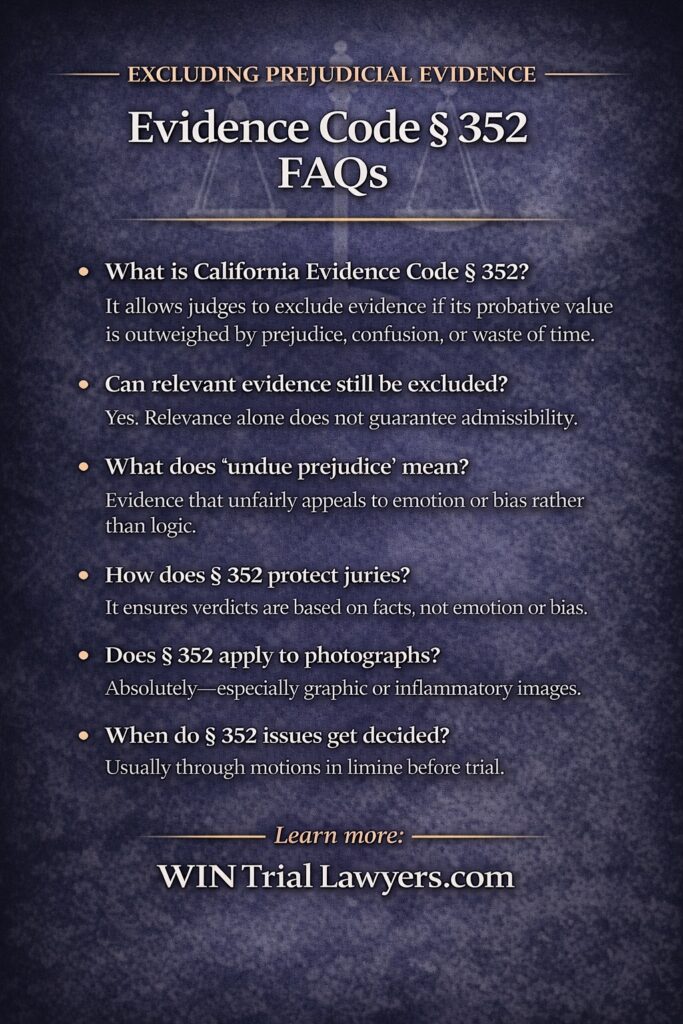
Frequently Asked Questions (FAQs)
What is California Evidence Code § 352?
It allows judges to exclude evidence if its probative value is outweighed by prejudice, confusion, or waste of time.
Can relevant evidence still be excluded?
Yes. Relevance alone does not guarantee admissibility.
What does “undue prejudice” mean?
Evidence that unfairly appeals to emotion or bias rather than logic.
Who decides whether § 352 applies?
The trial judge, using discretion and a balancing test.
Is § 352 commonly used in personal injury cases?
Yes. It is one of the most frequently invoked evidence rules in injury trials.
Can § 352 limit expert testimony?
Yes. Courts may limit or exclude expert opinions that are misleading or speculative.
Does § 352 apply to photographs and videos?
Absolutely—especially graphic or inflammatory images.
When are § 352 issues usually raised?
Most often through motions in limine before trial.
Can § 352 prevent irrelevant character evidence?
Yes. It is commonly used to exclude character attacks.
How does § 352 protect juries?
It ensures verdicts are based on facts, not emotion or bias.