

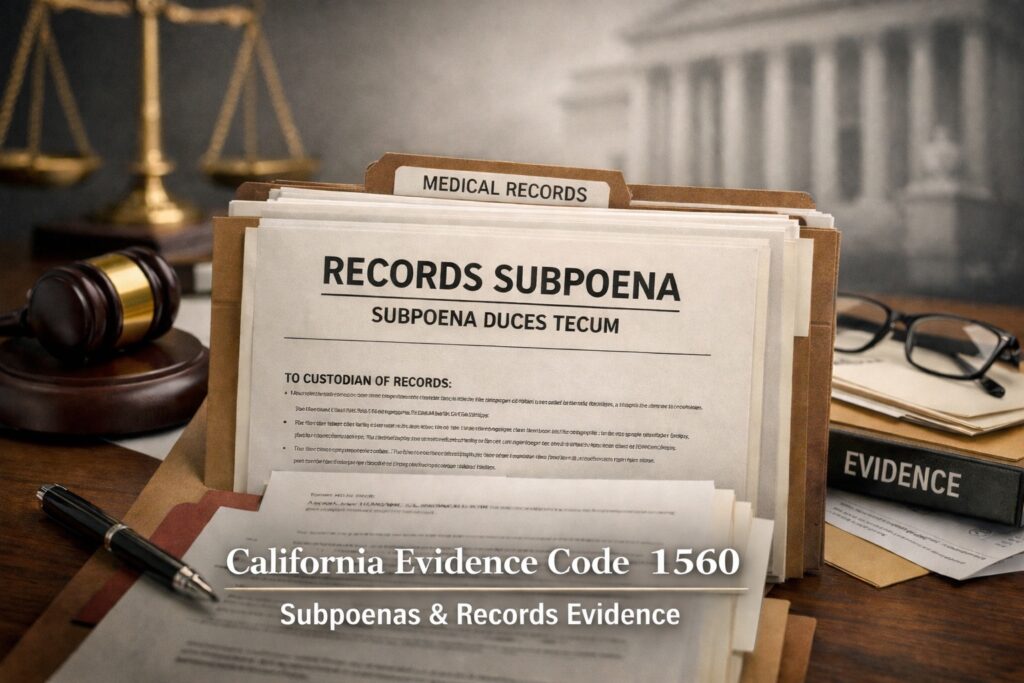
At WIN Injury & Accident Trial Lawyers, subpoenas are one of the most powerful tools we use to uncover the truth after a serious injury. California Evidence Code § 1560 governs subpoenas for the production of records—often called records subpoenas—and plays a critical role in personal injury, wrongful death, and catastrophic injury cases.
This guide explains what Evidence Code § 1560 is, how it works, and why it matters if you’ve been injured and crucial evidence is in someone else’s hands.
What Is California Evidence Code § 1560?
California Evidence Code § 1560 sets out the rules for subpoenaing business, medical, employment, and other records from third parties. Instead of requiring a live witness to appear in court, § 1560 allows records to be produced with a custodian of records declaration, streamlining the evidence process.
In injury cases, this statute is often used to obtain:
- Medical records
- Hospital billing statements
- Insurance files
- Employment and wage records
- Surveillance footage
- Cell phone and digital records
- Maintenance and inspection logs
Why Evidence Code § 1560 Is So Important in Injury Cases
After an accident, the most important evidence is rarely held by the injured person. Hospitals, employers, insurers, property owners, and corporations often control the records that prove:
- How the injury occurred
- The severity of the injuries
- Whether safety rules were followed
- Who is legally responsible
- The full value of damages
Evidence Code § 1560 allows injury victims to compel production of these records, even when companies are reluctant to cooperate.
What Types of Subpoenas Does EC § 1560 Cover?
Evidence Code § 1560 applies to subpoenas duces tecum, which require a person or entity to produce documents or records.
Common examples include:
- Medical provider subpoenas
- Employer payroll and personnel file subpoenas
- Surveillance video subpoenas
- Cell phone carrier subpoenas
- Bank and financial record subpoenas
What Is a Custodian of Records Declaration?
Instead of requiring a records custodian to testify in court, § 1560 allows records to be admitted with a written declaration from the custodian stating that:
- The records were made in the regular course of business
- The records were created at or near the time of the events
- The records are true and correct copies
- The custodian is qualified to certify them
This declaration often makes the records admissible without live testimony.
How Medical Records Are Subpoenaed Under EC § 1560
Medical records are among the most common subpoenas in personal injury cases. Under § 1560:
- The subpoena must strictly comply with privacy laws
- Proper notice must be given
- The custodian produces certified records
- Records can be used to prove injury, treatment, and damages
Medical subpoenas are often decisive in cases involving traumatic brain injuries, spinal injuries, orthopedic trauma, and wrongful death.
Are There Special Rules for Consumer Records?
Yes. Subpoenas for consumer records—such as medical, employment, or financial records—require:
- Advance notice to the consumer
- Proof of service of that notice
- Compliance with privacy protections
Failure to follow these rules can result in the subpoena being quashed.
Can a Subpoena Be Objected To or Quashed?
Yes. The person or entity receiving the subpoena may object if it is:
- Overly broad
- Unduly burdensome
- Violative of privacy rights
- Not reasonably calculated to lead to admissible evidence
Courts often balance the need for the records against privacy and burden concerns.
What Happens If Someone Ignores a Subpoena?
Ignoring a properly issued subpoena can result in:
- Court orders compelling compliance
- Monetary sanctions
- Contempt of court findings
Subpoenas under EC § 1560 carry real legal consequences.
How Subpoenas Help Prove Negligence
In injury cases, subpoenas are often used to uncover evidence of:
- Safety violations
- Prior similar incidents
- Poor maintenance practices
- Inadequate training
- Policy non-compliance
This evidence can dramatically strengthen a negligence claim.
Can Subpoenaed Records Be Used at Trial?
Yes. When properly certified under EC § 1560, subpoenaed records may be:
- Used in depositions
- Introduced at trial
- Relied upon by experts
- Presented to juries
These records often form the backbone of a successful injury case.
Subpoenas and Surveillance Evidence
Surveillance footage is frequently overwritten or destroyed. Prompt subpoenas under EC § 1560 can:
- Preserve video evidence
- Establish timelines
- Confirm liability
- Disprove false defenses
Early action is critical.
How WIN Injury & Accident Trial Lawyers Uses Subpoenas Strategically
At WIN Injury & Accident Trial Lawyers, subpoenas are not an afterthought—they are a core litigation strategy. We use Evidence Code § 1560 to:
- Lock in liability early
- Preserve disappearing evidence
- Expose unsafe practices
- Maximize damages
- Level the playing field against insurers and corporations
Our trial-focused approach ensures no critical document goes undiscovered.
Why Experience Matters With Subpoenas
Improperly drafted subpoenas can be delayed, quashed, or rendered useless. Experienced trial lawyers know how to:
- Draft targeted subpoenas
- Anticipate objections
- Navigate privacy laws
- Enforce compliance
This expertise often makes the difference between a weak case and a powerful one.
Injured and Evidence Is Being Withheld?
If you were seriously injured and key records are being withheld or delayed, timing matters. Evidence can disappear, memories fade, and data can be overwritten.
📞 Contact WIN Injury & Accident Trial Lawyers today to protect your rights and ensure critical evidence is preserved and produced under California law.
Get Help From WIN Injury & Accident Trial Lawyers
Why Legal Representation Matters
Insurance companies often undervalue pain and suffering—offering minimal settlements that ignore your daily struggles. A skilled attorney can:
- Present powerful evidence of your emotional and physical suffering
- Retain expert witnesses to quantify your losses
- Use verdict data to justify higher multipliers or per diem rates
- Argue your case persuasively before a jury
At WIN Trial Lawyers, our team fights to ensure that your recovery reflects the full extent of your suffering—not just your bills.

At WIN Trial Lawyers, we know how personal injury claims can be can be. Victims often face mounting medical bills, lost wages, and emotional trauma. Our team has successfully taken on insurance companies and third parties, recovering millions for injured clients.
If you or a loved one has been injured in an accident, don’t leave your future in the hands of the insurance company. You need experienced trial lawyers who know how to prove liability and fight for maximum compensation.
If you or a loved one has been injured, don’t face this alone. The sooner you act, the stronger your case will be.
🔗 Related Posts:
California Evidence Code § 1560 – Subpoenas FAQs
What is California Evidence Code § 1560?
California Evidence Code § 1560 governs subpoenas for the production of records, allowing parties to obtain documents from third parties without requiring a live witness to appear in court.
What is a records subpoena?
A records subpoena (subpoena duces tecum) is a legal demand requiring a business, hospital, employer, or other entity to produce documents or records relevant to a case.
Why are subpoenas important in personal injury cases?
Most critical evidence—medical records, surveillance video, employment files, insurance records—is not in the injured person’s possession. Subpoenas compel third parties to produce this evidence.
What types of records can be subpoenaed under EC § 1560?
Common records include:
- Medical and hospital records
- Billing and insurance records
- Employment and payroll records
- Surveillance footage
- Cell phone and digital records
- Maintenance and inspection logs
- Police and incident reports (with limits)
Does EC § 1560 apply to medical records?
Yes. Medical records are one of the most frequently subpoenaed records under Evidence Code § 1560, subject to strict privacy and notice requirements.
What is a custodian of records?
A custodian of records is a person responsible for maintaining records who can certify that the documents were created and kept in the regular course of business.
Do custodians have to testify in court?
Usually not. Under EC § 1560, records can be admitted with a custodian of records declaration, eliminating the need for live testimony.
What is a custodian of records declaration?
It is a sworn statement confirming that:
- The records were made in the regular course of business
- The records were created at or near the time of the events
- The copies are true and correct
This declaration often makes the records admissible.
Are subpoenaed records automatically admissible at trial?
Not automatically. The records must still comply with other evidence rules, including relevance, hearsay exceptions, and authenticity.
What are “consumer records”?
Consumer records include personal records such as:
- Medical records
- Employment records
- Financial records
- Educational records
These records receive heightened privacy protection.
Are there special notice requirements for consumer records?
Yes. The consumer must receive advance notice before records are produced, giving them an opportunity to object or seek a protective order.
What happens if proper notice is not given?
Failure to provide proper notice can result in the subpoena being quashed, delayed, or excluded from evidence.
Can someone object to a subpoena?
Yes. Objections may be made if the subpoena is:
- Overly broad
- Unduly burdensome
- Invasive of privacy
- Not reasonably related to the case
What does it mean to “quash” a subpoena?
To quash a subpoena means to invalidate or cancel it, either entirely or in part.
What happens if a business ignores a subpoena?
Ignoring a valid subpoena can lead to:
- Court orders compelling compliance
- Monetary sanctions
- Contempt of court
Can subpoenas be enforced by the court?
Yes. Courts have broad authority to enforce subpoenas issued under Evidence Code § 1560.
How long does a subpoenaed party have to respond?
Response deadlines vary, but subpoenas typically specify a production date that must allow reasonable time for compliance.
Can electronic records be subpoenaed?
Yes. Electronic records such as emails, digital files, metadata, and surveillance video can all be subpoenaed under EC § 1560.
Can surveillance video be subpoenaed?
Yes—and timing is critical. Surveillance footage is often overwritten, making early subpoenas essential.
Are subpoenas used before a lawsuit is filed?
In limited situations, subpoenas may be used pre-litigation, but most subpoenas are issued after a case is filed.
Can subpoenas be used against insurance companies?
Yes. Insurance claim files, adjuster notes, and coverage records may be subpoenaed when relevant and properly limited.
Can an employer be subpoenaed in an injury case?
Yes. Employers may be subpoenaed for wage records, personnel files, job descriptions, and work schedules.
Can banks and financial institutions be subpoenaed?
Yes, but financial records receive strong privacy protections and require strict compliance with notice rules.
Are police reports subpoenaed under EC § 1560?
Police reports may be subpoenaed, but portions containing opinions or third-party statements may be excluded.
Can subpoenaed records be used in depositions?
Yes. Subpoenaed records are frequently used to question witnesses and experts during depositions.
What happens if records are incomplete or missing?
Missing or altered records may support:
- Adverse inferences
- Credibility attacks
- Spoliation arguments
Can subpoena defects be fixed?
Sometimes. Courts may allow amended subpoenas or additional declarations to cure technical defects.
Are subpoenas used in wrongful death cases?
Yes. Subpoenas are critical in wrongful death cases to obtain medical, employment, financial, and incident records.
How do subpoenas help prove negligence?
Subpoenaed records often reveal:
- Safety violations
- Prior similar incidents
- Failure to maintain property
- Inadequate training or policies
Are subpoenas commonly challenged by defendants?
Yes. Defendants and third parties frequently challenge subpoenas to delay or limit damaging evidence.
Why does having an experienced injury lawyer matter?
Improper subpoenas can be quashed or delayed. Experienced trial lawyers know how to:
- Draft targeted subpoenas
- Navigate privacy laws
- Enforce compliance
- Anticipate objections
How does WIN Injury & Accident Trial Lawyers use subpoenas?
WIN Injury & Accident Trial Lawyers uses Evidence Code § 1560 subpoenas strategically to uncover hidden evidence, preserve records, and build strong injury cases.
What should I do if I think evidence is being withheld?
You should speak with an experienced injury lawyer immediately. Delays can result in lost or destroyed evidence.
Can subpoenas increase the value of a personal injury case?
Yes. Strong documentary evidence often increases leverage in settlement negotiations and at trial.
Are subpoenas confidential?
Often yes, especially when consumer records are involved, but courts may issue protective orders to safeguard privacy.
Do I need a lawyer to issue a subpoena?
While technically possible without a lawyer, subpoenas are complex, and mistakes can jeopardize critical evidence.