
What Does Evidence Code 720 Say?
California Evidence Code 720 governs who is qualified to testify as an expert witness in a civil trial. Before an expert can offer opinions to a jury, the court must determine whether that person has the necessary qualifications to do so.
In simple terms, the law asks:
Is this witness truly qualified to give expert opinions that will help the jury?
Expert testimony can shape liability, causation, and damages—so qualifications matter.
The Text of Evidence Code 720
“A person is qualified to testify as an expert if he has special knowledge, skill, experience, training, or education sufficient to qualify him as an expert on the subject to which his testimony relates.”
The statute focuses on practical competence, not titles alone.
What Makes Someone an “Expert” Under EC 720?
An expert does not need to be the best in the field or hold a specific license. Instead, courts look at whether the witness has sufficient:
- Specialized knowledge
- Practical experience
- Professional training
- Formal education
- Skill gained through real-world work
The key question is whether the expert’s background will assist the jury in understanding evidence or deciding facts.
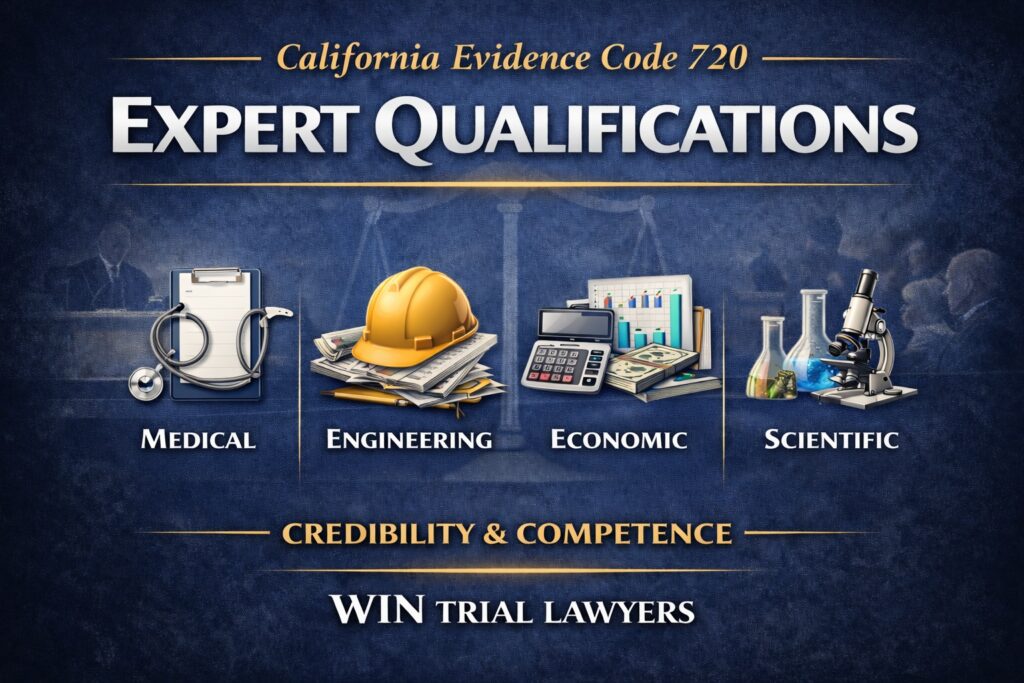
Common Types of Experts in Personal Injury Cases
Evidence Code § 720 frequently arises when parties challenge expert qualifications in injury and negligence cases.
Medical Experts
- Treating physicians
- Surgeons and specialists
- Pain management doctors
- Rehabilitation and disability experts
Challenges often focus on scope—what opinions the doctor is actually qualified to give.
Engineering & Technical Experts
- Accident reconstructionists
- Biomechanical engineers
- Safety and human factors experts
- Structural or mechanical engineers
Courts examine whether the expert’s training matches the specific opinions offered.
Economic & Vocational Experts
- Economists
- Life-care planners
- Vocational rehabilitation experts
These experts must show expertise in calculating future losses, not just general business knowledge.
Scientific & Industry Experts
- Product safety specialists
- Toxicology or materials experts
- Industry standards professionals
Experience within the industry often matters more than academic credentials.
Qualifications vs. Credibility
Evidence Code 720 addresses admissibility, not weight.
- Qualification → decided by the judge
- Credibility → decided by the jury
Once an expert meets the minimum threshold, opposing counsel may still challenge:
- Bias
- Methodology
- Assumptions
- Inconsistencies
But those attacks go to weight, not exclusion.
How Courts Decide Expert Qualifications
Judges typically consider:
- Education and degrees
- Licenses or certifications (if relevant)
- Years of experience
- Practical hands-on work
- Prior expert testimony
- Publications or teaching (helpful, not required)
A lack of one factor does not disqualify an expert if others are strong.
Common Expert Qualification Challenges
Defense challenges under EC 720 often argue that:
- The expert is testifying outside their specialty
- Experience is outdated or irrelevant
- Opinions exceed training or education
- The expert relies on speculation
Plaintiffs frequently challenge defense experts as:
- “Professional witnesses”
- Lacking real-world experience
- Unqualified to opine on causation
Why Evidence Code 720 Is So Important
Expert testimony often:
- Establishes causation
- Explains technical evidence
- Drives damages calculations
- Influences settlement value
Disqualifying—or limiting—an expert can significantly change the outcome of a case.
How WIN Trial Lawyers Uses Evidence Code 720
At WIN Trial Lawyers, we use EC 720 to:
- Vet and prepare qualified experts
- Defend expert admissibility at hearings
- Limit overreaching defense experts
- Expose qualification gaps during cross-examination
Experts should help jurors—not confuse or mislead them.
Get Help From WIN Injury & Accident Trial Lawyers
Why Legal Representation Matters
Insurance companies often undervalue pain and suffering—offering minimal settlements that ignore your daily struggles. A skilled attorney can:
- Present powerful evidence of your emotional and physical suffering
- Retain expert witnesses to quantify your losses
- Use verdict data to justify higher multipliers or per diem rates
- Argue your case persuasively before a jury
At WIN Trial Lawyers, our team fights to ensure that your recovery reflects the full extent of your suffering—not just your bills.

At WIN Trial Lawyers, we know how personal injury claims can be can be. Victims often face mounting medical bills, lost wages, and emotional trauma. Our team has successfully taken on insurance companies and third parties, recovering millions for injured clients.
If you or a loved one has been injured in an accident, don’t leave your future in the hands of the insurance company. You need experienced trial lawyers who know how to prove liability and fight for maximum compensation.
If you or a loved one has been injured, don’t face this alone. The sooner you act, the stronger your case will be.
🔗 Related Posts:
Frequently Asked Questions (FAQs)
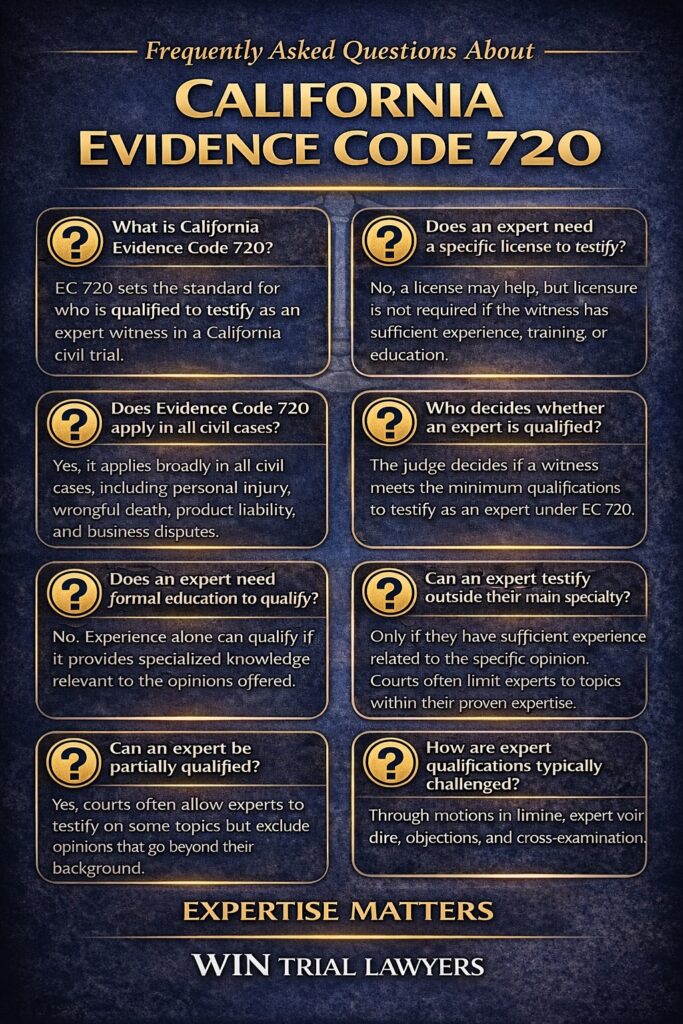
Frequently Asked Questions About California Evidence Code 720
What is California Evidence Code 720?
Evidence Code 720 sets the standard for who may testify as an expert witness in a California civil trial. It requires that an expert have sufficient knowledge, skill, experience, training, or education to offer opinions that will help the jury.
What does “expert qualifications” mean?
Expert qualifications refer to whether a witness has specialized knowledge beyond that of an ordinary person that makes their opinions reliable and helpful to the jury.
Does an expert need a specific license to testify?
No. A license may help, but licensure is not required if the witness has sufficient experience, training, or education in the relevant subject area.
Who decides whether an expert is qualified?
The judge decides whether a witness meets the minimum qualifications to testify as an expert under Evidence Code 720.
Does Evidence Code 720 apply in all civil cases?
Yes. It applies broadly in all civil cases, including personal injury, wrongful death, product liability, medical negligence, and business disputes.
What kinds of experts are commonly challenged under EC 720?
Commonly challenged experts include:
- Medical professionals testifying outside their specialty
- Engineers opining beyond their technical background
- Economists offering medical or vocational opinions
- “Professional experts” with limited real-world experience
Can a treating doctor testify as an expert?
Yes. Treating physicians often qualify as experts regarding diagnosis, treatment, prognosis, and causation, even if they were not hired solely for litigation.
Does an expert need formal education to qualify?
No. Experience alone can qualify a witness as an expert if it provides specialized knowledge relevant to the opinions offered.
Can an expert testify outside their main specialty?
Only if they have sufficient training or experience related to the specific opinion. Courts often limit experts to topics within their proven expertise.
What happens if an expert is not qualified under EC 720?
If the judge finds the expert unqualified, the expert’s opinions may be:
- Completely excluded, or
- Limited to certain subjects
This can significantly impact the case.
Does Evidence Code 720 guarantee the expert will be believed?
No. Qualification only allows the testimony to be heard. Credibility and weight are decided by the jury.
How are expert qualifications typically challenged?
Expert qualifications are commonly challenged through:
- Motions in limine
- Expert voir dire
- Objections during trial
- Cross-examination
Can an expert be partially qualified?
Yes. Courts often allow experts to testify on some topics but exclude opinions that go beyond their background.
Is Evidence Code 720 the same as the Kelly/Frye or Daubert standards?
No. Evidence Code 720 addresses who may testify as an expert. Kelly/Frye and related standards address whether the expert’s methodology is reliable.
Can experience alone qualify someone as an expert?
Yes. Courts regularly qualify experts based on hands-on, real-world experience, even without advanced degrees.
Can industry professionals qualify as experts?
Yes. Industry experts with substantial practical experience may qualify, especially in product liability and safety cases.
Does EC 720 apply to defense experts and plaintiff experts equally?
Yes. The statute applies equally to both sides.
Can an expert’s qualifications be attacked after they testify?
Yes. Even if qualified, experts can be challenged on:
- Bias
- Inconsistent opinions
- Weak assumptions
- Limited experience
These attacks go to credibility, not admissibility.
Does Evidence Code 720 require prior expert testimony experience?
No. A witness does not need prior courtroom experience to qualify as an expert.
Can an expert rely on knowledge gained after the incident?
Yes. Experts may rely on education or experience obtained after the event, as long as it supports the opinions offered.
Why are expert qualifications so important in injury cases?
Expert testimony often establishes:
- Causation
- Standard of care
- Future medical needs
- Economic damages
Weak expert qualifications can undermine an entire case.
Can expert qualifications affect settlement value?
Absolutely. Strong, credible experts often increase settlement value, while questionable experts weaken negotiating leverage.
Can Evidence Code 720 limit testimony even if the expert is qualified?
Yes. Judges may limit testimony to prevent experts from:
- Speculating
- Offering legal conclusions
- Testifying outside their expertise
How does EC 720 protect juries?
It prevents juries from being influenced by unqualified opinions and ensures expert testimony is grounded in real expertise.
How does WIN Trial Lawyers use Evidence Code 720?
WIN uses EC 720 to:
- Select highly qualified experts
- Defend expert admissibility
- Exclude or limit unqualified defense experts
- Expose expertise gaps through cross-examination
Expert testimony should clarify—not confuse—the issues for jurors.