

What Does Evidence Code 413 Say?
California Evidence Code 413 addresses situations where a party suppresses, conceals, or withholds evidence. When that happens, jurors are allowed to consider whether the evidence was hidden because it would have been unfavorable to that party.
In simple terms, the law recognizes a basic principle of fairness:
People usually do not hide evidence that helps them.
The Text of Evidence Code 413
“In determining what inferences to draw from the evidence or facts in the record, the trier of fact may consider, among other things, the party’s failure to explain or deny evidence against the party, or the party’s suppression of evidence.”
This statute gives jurors permission to connect the dots when evidence appears to be intentionally kept out of view.
What Is “Suppression of Evidence”?
Suppression of evidence occurs when a party:
- Intentionally withholds evidence
- Conceals evidence from discovery
- Fails to disclose required materials
- Deletes, alters, or hides information
- Prevents evidence from being accessed or reviewed
Unlike Evidence Code 412, § 413 focuses on conduct, not just absence.
Common Examples in Personal Injury Cases
Evidence Code § 413 frequently applies in injury and negligence cases where defendants control critical proof and actively take steps to keep it from being seen. Unlike missing evidence, these situations often suggest intentional concealment rather than oversight.
Auto & Truck Accidents
Commercial drivers and fleet operators often possess decisive post-collision evidence. § 413 may apply when there is:
- Deleting or overwriting dashcam footage, especially after a serious crash
- Withholding black-box / EDR data that could reveal speed, braking, or driver behavior
- Failing to disclose prior safety violations, inspections, or citations that show a pattern of negligence
Active suppression of this information can strongly support an inference of fault.
Premises Liability
Businesses routinely generate and store internal safety records. Red flags include:
- Concealing or selectively producing surveillance footage from the time of the incident
- Failing to produce internal emails or prior safety complaints about the same hazard
- Withholding maintenance logs or cleaning schedules that would show notice and neglect
Jurors may reasonably question why this evidence was kept out of view.
Product Liability
Manufacturers often have extensive knowledge of product risks long before injuries occur. § 413 commonly arises when companies:
- Suppress internal safety testing or engineering analyses
- Hide known defect reports or prior injury complaints
- Withhold information about prior incidents, recalls, or redesigns
Concealment in these cases often points to knowledge of danger.
Medical & Institutional Negligence
Hospitals and institutions are expected to document care accurately and completely. Suppression may include:
- Altering, omitting, or backdating medical chart entries
- Concealing internal policies, protocols, or training deficiencies
- Suppressing adverse event reports or internal reviews
When records are manipulated or selectively disclosed, jurors may infer conscious wrongdoing.
Why Evidence Code 413 Is So Powerful for Plaintiffs
Evidence Code § 413 allows plaintiffs to argue intent and credibility without direct proof of motive.
It can help establish:
- Knowledge of danger
- Awareness of wrongdoing
- Conscious disregard for safety
- Dishonesty or lack of transparency
Few things undermine a defense faster than evidence of suppression.
How Juries Are Allowed to Use § 413
Jurors may:
- Infer the suppressed evidence would have been unfavorable
- Question the credibility of the suppressing party
- Weigh concealment when assessing fault or liability
- Consider suppression as part of the overall narrative
The statute does not require jurors to draw an inference — it allows them to.
Evidence Code § 413 vs. Evidence Code § 412
These statutes often work together but serve different purposes:
| Evidence Code 412 | Evidence Code 413 |
|---|---|
| Missing or unexplained evidence | Suppressed or concealed evidence |
| No intent required | Intentional conduct |
| Credibility inference | Adverse inference |
| Passive failure | Active concealment |
A case may involve both statutes at the same time.
Evidence Code § 413 and Spoliation
Evidence Code § 413 overlaps with spoliation but is broader.
- Spoliation often focuses on destruction
- § 413 includes concealment, withholding, or suppression
Even if sanctions are not imposed, jurors may still consider suppression under § 413.
How WIN Trial Lawyers Uses Evidence Code 413
At WIN Trial Lawyers, we use Evidence Code § 413 to:
- Expose concealment during discovery
- Highlight inconsistencies in testimony
- Demonstrate awareness of danger or liability
- Frame powerful jury instructions and closing arguments
When evidence is hidden, we make sure jurors understand why.
Get Help From WIN Injury & Accident Trial Lawyers
Why Legal Representation Matters
Insurance companies often undervalue pain and suffering—offering minimal settlements that ignore your daily struggles. A skilled attorney can:
- Present powerful evidence of your emotional and physical suffering
- Retain expert witnesses to quantify your losses
- Use verdict data to justify higher multipliers or per diem rates
- Argue your case persuasively before a jury
At WIN Trial Lawyers, our team fights to ensure that your recovery reflects the full extent of your suffering—not just your bills.

At WIN Trial Lawyers, we know how personal injury claims can be can be. Victims often face mounting medical bills, lost wages, and emotional trauma. Our team has successfully taken on insurance companies and third parties, recovering millions for injured clients.
If you or a loved one has been injured in an accident, don’t leave your future in the hands of the insurance company. You need experienced trial lawyers who know how to prove liability and fight for maximum compensation.
If you or a loved one has been injured, don’t face this alone. The sooner you act, the stronger your case will be.
🔗 Related Posts:
Frequently Asked Questions (FAQs)
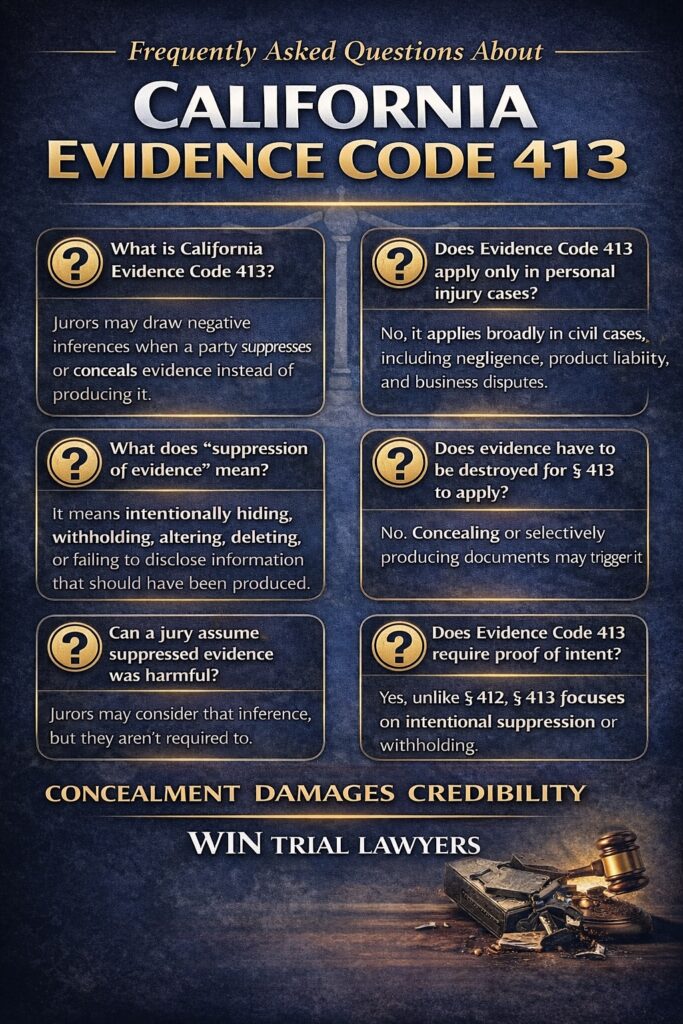
What is California Evidence Code 413?
Evidence Code 413 allows jurors to draw negative inferences when a party suppresses, conceals, or withholds evidence instead of producing it.
What does “suppression of evidence” mean?
Suppression means actively keeping evidence from being seen, such as hiding, withholding, altering, deleting, or failing to disclose information that should have been produced.
How is Evidence Code 413 different from missing evidence?
Evidence Code 413 focuses on intentional conduct, not just absence. It applies when evidence is hidden or withheld on purpose, not merely unavailable.
Does Evidence Code 413 apply only in personal injury cases?
No. It applies in all civil cases, but it is especially powerful in personal injury, product liability, and negligence cases where defendants control key evidence.
Does evidence have to be destroyed for § 413 to apply?
No. Destruction is not required. Withholding, concealing, or selectively producing evidence can trigger § 413.
Can a jury assume suppressed evidence was harmful?
Jurors are permitted to consider that inference, but they are not required to. The statute allows the inference — it does not mandate it.
Does Evidence Code 413 require proof of intent?
Yes. Unlike Evidence Code 412, § 413 is focused on intentional suppression or concealment, which can be proven through circumstantial evidence.
How is intent usually shown?
Intent is often shown through:
- Timing of deletion or withholding
- Inconsistent explanations
- Selective document production
- Violations of record-keeping policies
- Testimony contradicting written records
Direct admissions are rare.
Can Evidence Code 413 apply to digital evidence?
Absolutely. Common examples include:
- Deleted videos or dashcam footage
- Withheld emails or text messages
- Missing metadata
- Altered electronic records
Digital suppression is one of the most common § 413 issues today.
Is Evidence Code 413 the same as spoliation?
No. Spoliation usually involves destruction of evidence and potential sanctions. Evidence Code 413 is broader and allows jurors to consider concealment or withholding, even without sanctions.
Can § 413 apply even if no spoliation motion was filed?
Yes. Jurors may consider suppression even if the judge did not impose sanctions or the court never ruled on spoliation.
Who decides whether Evidence Code 413 applies?
The jury ultimately decides what inferences to draw, based on the evidence and the judge’s instructions.
Does Evidence Code 413 shift the burden of proof?
No. The plaintiff still bears the burden of proof. § 413 affects credibility and inference, not burden shifting.
Can Evidence Code 413 be argued during closing argument?
Yes. It is commonly used in closing arguments to explain why certain evidence is missing and what that concealment suggests.
Can § 413 apply to missing witnesses?
Yes. If a party fails to call a witness under their control and cannot explain why, jurors may consider whether testimony was intentionally withheld.
Does Evidence Code 413 apply to businesses and corporations?
Yes. Corporations are frequent targets of § 413 because they control records, systems, employees, and internal investigations.
Can suppression be inferred even if some documents were produced?
Yes. Selective disclosure — producing favorable documents while withholding unfavorable ones — often strengthens a § 413 argument.
How does Evidence Code 413 affect credibility?
Suppression can seriously undermine credibility and cause jurors to:
- Distrust testimony
- Question explanations
- View the defense narrative skeptically
Credibility damage can be case-decisive.
Can Evidence Code 413 apply if evidence was “lost”?
It depends. If the loss appears suspicious, poorly explained, or inconsistent with standard practices, jurors may infer suppression.
Why is Evidence Code 413 so powerful for plaintiffs?
Because jurors strongly dislike concealment. Suppression suggests:
- Knowledge of wrongdoing
- Awareness of danger
- Dishonesty
- Lack of accountability
Few things damage a defense more.
How does Evidence Code 413 interact with Evidence Code 412?
They often work together:
- § 412 addresses unexplained missing evidence
- § 413 addresses intentional suppression
A single case may involve both.
Does Evidence Code 413 require expert testimony?
No. It relies on logic and common sense, though experts may explain why certain evidence should exist.
Can suppression be shown through patterns?
Yes. Repeated failures, selective disclosures, or inconsistent explanations can collectively establish suppression.
How does WIN Trial Lawyers use Evidence Code 413?
WIN uses § 413 to:
- Expose concealment during discovery
- Highlight credibility issues at trial
- Show knowledge and intent
- Frame compelling jury arguments
When evidence is hidden, we make sure jurors understand why that matters.