


What Does Evidence Code 1417 Say?
California Evidence Code 1417 governs how physical evidence must be accounted for from the moment it is collected to the moment it is presented in court. This process is known as chain of custody.
In plain terms, the statute answers this question:
Can the court trust that this evidence is the same item, in the same condition, as when it was first collected?
In personal injury and car accident cases, chain of custody is critical whenever physical evidence is used to prove liability, causation, or damages.
The Rule Behind Evidence Code 1417 (Simplified)
Evidence Code 1417 requires that physical evidence be authenticated through a showing of reasonable assurance that:
- The item offered in court is the same item collected
- The evidence has not been materially altered
- The handling, storage, and transfer of the evidence were properly documented
The law does not require perfection—but it does require reliability.
What Is “Chain of Custody”?
Chain of custody refers to the documented history of an item of evidence, including:
- Who collected it
- When and where it was collected
- How it was labeled
- Who handled it afterward
- How it was stored
- When it was transferred
Each link in the chain helps establish that the evidence is trustworthy.
How Chain of Custody Applies in Personal Injury & Car Accident Cases
Chain of custody issues arise far more often in civil cases than most people realize—especially when physical evidence plays a central role.
Car Accident & Vehicle Evidence
In auto and trucking cases, chain of custody frequently applies to:
- Vehicle parts removed after a crash
- Brake components, tires, or airbags
- Event data recorders (black boxes)
- Dashcams or onboard video devices
- Debris collected from the roadway
If the defense challenges how these items were handled, the evidence may be limited or excluded.
Medical Evidence & Biological Samples
In serious injury cases, chain of custody may apply to:
- Blood or urine samples
- Toxicology evidence
- Medical devices removed during treatment
- Clothing worn at the time of injury
Proper handling is essential to prevent contamination or substitution arguments.
Digital & Physical Media Evidence
Chain of custody is not limited to physical objects. It also applies to:
- Photographs stored on devices
- Surveillance video
- Bodycam or dashcam footage
- Memory cards and hard drives
Courts look closely at whether digital evidence was preserved without alteration.
What the Law Requires — and What It Does Not
Evidence Code 1417 does not require:
- Every person in the chain to testify
- Absolute certainty
- A flawless record
Instead, the standard is reasonable assurance that the evidence is what it purports to be.
Minor gaps typically go to weight, not admissibility.
Common Chain of Custody Challenges in Injury Cases
Defense attorneys often argue:
- Evidence was improperly handled
- The chain was broken or undocumented
- Evidence could have been altered or contaminated
- Too many people had access to the item
Courts evaluate whether these concerns create reasonable doubt about reliability.
Chain of Custody vs. Authentication
| Concept | Purpose |
|---|---|
| Authentication | Is this what the party claims it is? |
| Chain of Custody | Has it been reliably preserved? |
| EC § 1417 | Governs handling of physical evidence |
| EC § 1401 | Governs authentication generally |
Chain of custody is often a subset of authentication.
Why Chain of Custody Matters to Juries
Jurors tend to trust physical evidence—but only if they believe:
- It has not been tampered with
- It was carefully preserved
- It reflects reality
A weak chain of custody can undermine even strong evidence.
How Chain of Custody Issues Are Resolved
Most chain of custody disputes are addressed through:
- Pretrial motions
- Evidentiary hearings
- Foundation testimony
- Cross-examination
Judges balance fairness against the risk of misleading the jury.
How WIN Trial Lawyers Uses Evidence Code 1417
At WIN Trial Lawyers, we use chain of custody rules to:
- Protect critical physical evidence
- Defeat defense claims of tampering
- Expose mishandling by opposing parties
- Strengthen the credibility of demonstrative proof
Well-preserved evidence tells a clear story.
Get Help From WIN Injury & Accident Trial Lawyers

Why Legal Representation Matters
Insurance companies often undervalue pain and suffering—offering minimal settlements that ignore your daily struggles. A skilled attorney can:
- Present powerful evidence of your emotional and physical suffering
- Retain expert witnesses to quantify your losses
- Use verdict data to justify higher multipliers or per diem rates
- Argue your case persuasively before a jury
At WIN Trial Lawyers, our team fights to ensure that your recovery reflects the full extent of your suffering—not just your bills.

At WIN Trial Lawyers, we know how personal injury claims can be can be. Victims often face mounting medical bills, lost wages, and emotional trauma. Our team has successfully taken on insurance companies and third parties, recovering millions for injured clients.
If you or a loved one has been injured in an accident, don’t leave your future in the hands of the insurance company. You need experienced trial lawyers who know how to prove liability and fight for maximum compensation.
If you or a loved one has been injured, don’t face this alone. The sooner you act, the stronger your case will be.
🔗 Related Posts:
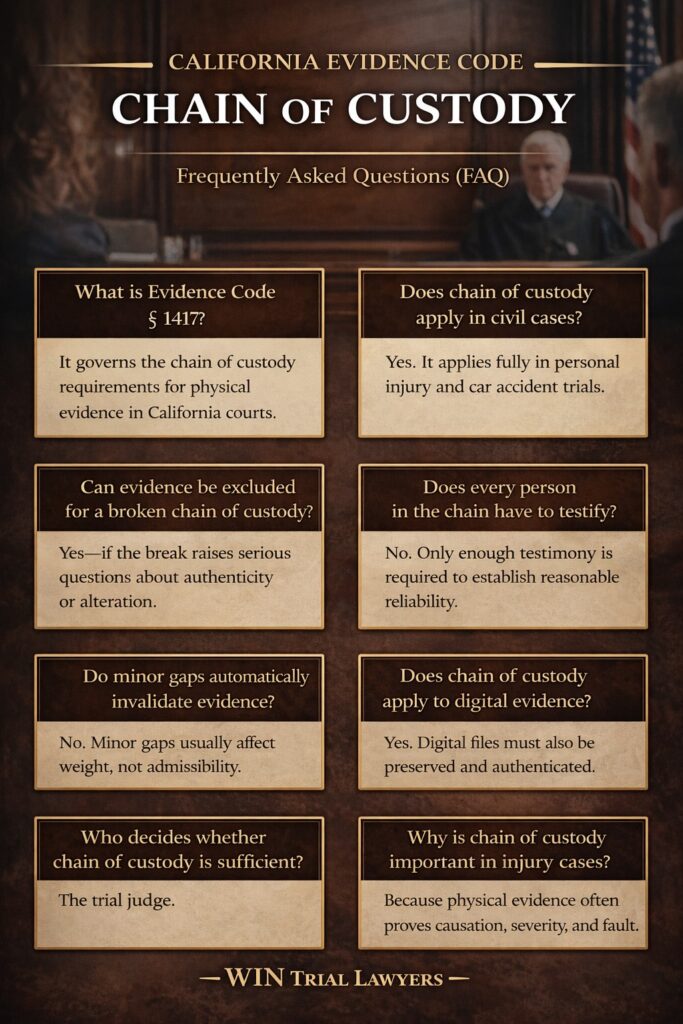
California Evidence Code § 1417 – Chain of Custody FAQs
What is California Evidence Code § 1417?
California Evidence Code § 1417 governs chain of custody—the requirement that physical or digital evidence be shown to be the same item collected, and not altered, substituted, or tampered with, from the time it was obtained to the time it is offered in evidence.
Why is chain of custody important?
Chain of custody protects the integrity and reliability of evidence. If a party cannot establish an adequate chain, the court may exclude the evidence or give it little weight.
What types of evidence require a chain of custody?
Chain of custody issues most often arise with:
- Physical objects
- Drugs or biological samples
- Weapons or tools
- Surveillance video and digital files
- Blood, DNA, or toxicology samples
- Cell phones and electronic devices
- Product exemplars in defect cases
Does every piece of evidence require a chain of custody?
No. Chain of custody is primarily required when evidence is not readily identifiable or is susceptible to alteration, substitution, or contamination.
What is the purpose of Evidence Code § 1417?
The statute ensures that the evidence presented at trial is authentic and trustworthy, and that it accurately reflects what was originally collected.
What must be shown to establish a proper chain of custody?
The proponent must show:
- Where the evidence came from
- Who handled it
- How it was stored
- That it was not materially altered
The standard is reasonable certainty, not absolute certainty.
Is the chain of custody required to be perfect?
No. California law does not require a perfect or unbroken chain. Minor gaps typically affect weight, not admissibility, unless there is evidence of actual tampering or substitution.
What is a “link” in the chain of custody?
A link is each person or entity that had possession or control of the evidence from collection through trial.
Does every link need to testify?
No. Not every custodian must testify. The proponent only needs to establish reasonable assurance of the evidence’s integrity.
What happens if there is a missing link?
A missing link does not automatically make evidence inadmissible. Courts consider:
- The nature of the evidence
- The length of the gap
- Whether tampering is reasonably likely
Who bears the burden of establishing chain of custody?
The party offering the evidence bears the burden of establishing an adequate chain of custody.
What standard do courts apply under § 1417?
Courts apply a reasonable probability or reasonable certainty standard—not proof beyond all doubt.
How does chain of custody differ from authentication?
Authentication establishes what the evidence is. Chain of custody establishes that it is the same item and has not been altered.
Can chain of custody issues be raised by objection?
Yes. Common objections include:
- Lack of foundation
- Speculation
- Possibility of tampering
- Inadequate documentation
Is chain of custody a jury question or judge question?
Admissibility is decided by the judge. Weaknesses in the chain go to weight, which the jury may consider.
Does chain of custody apply to digital evidence?
Yes. Digital evidence requires proof of:
- How it was captured
- How it was stored
- Whether it was edited, copied, or altered
- Who had access to it
How is chain of custody established for surveillance video?
Typically through testimony describing:
- The recording system
- How footage is stored
- How the footage was retrieved
- That the footage is a true and accurate copy
Are copies of evidence subject to chain of custody rules?
Yes, especially where accuracy or completeness is disputed. Courts often require proof that the copy is identical to the original.
How does chain of custody apply to cell phones?
Cell phone evidence requires proof of:
- Who seized the device
- How it was stored
- Whether it was accessed or modified
- How data was extracted
Can chain of custody be established through documents alone?
Sometimes. Logs, evidence tags, and tracking records can establish chain of custody without live testimony, unless challenged.
What is an evidence log?
An evidence log documents:
- Date and time of collection
- Identity of collector
- Transfers of possession
- Storage conditions
Does improper storage break the chain of custody?
Improper storage may undermine reliability, but it does not automatically bar admission unless it creates a reasonable probability of alteration.
Can chain of custody issues be raised in motions in limine?
Yes. Chain of custody challenges are commonly raised before trial through motions in limine.
How does chain of custody apply in criminal cases?
Chain of custody is especially important in criminal cases involving drugs, weapons, or forensic evidence, but the standard remains reasonable certainty.
Is chain of custody required in civil cases?
Yes. Civil cases involving physical or electronic evidence often require chain of custody proof, particularly in product liability, employment, and personal injury cases.
Can chain of custody defects be cured at trial?
Sometimes. Additional testimony or documentation may cure minor defects if offered before the close of evidence.
What happens if evidence was lost or destroyed?
Loss or destruction may lead to:
- Exclusion of evidence
- Adverse inference instructions
- Spoliation sanctions
Does Evidence Code § 1417 require proof of no tampering?
No. The law requires reasonable assurance, not proof that tampering was impossible.
How do courts evaluate allegations of tampering?
Courts look for actual evidence of tampering, not mere speculation.
Can chain of custody be stipulated to?
Yes. Parties often stipulate to chain of custody to streamline trials and focus on substantive issues.
How does chain of custody affect expert testimony?
Experts may rely on evidence only if its integrity is established. A broken chain can undermine expert opinions.
Is chain of custody relevant in arbitrations?
Yes. Arbitrators frequently consider chain of custody, especially for digital and physical evidence.
How can lawyers strengthen chain of custody?
Best practices include:
- Clear evidence handling protocols
- Detailed logs
- Limited access
- Early documentation
- Anticipating objections
How can chain of custody hurt a party’s case?
Weak chains can:
- Undermine credibility
- Lead to exclusion
- Reduce evidentiary weight
- Support spoliation claims
Is chain of custody often outcome-determinative?
Yes. In many cases, evidence integrity determines admissibility, which can directly affect liability and damages.