

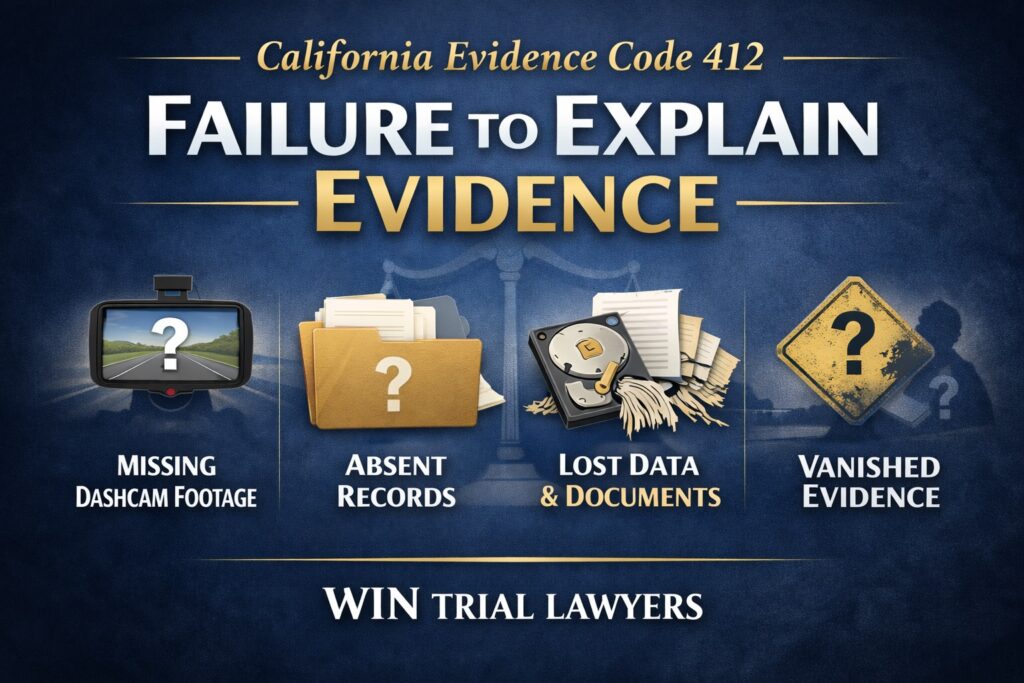
What Does Evidence Code § 412 Say?
California Evidence Code § 412 addresses a powerful concept in civil trials: when a party fails to explain or produce evidence that is reasonably within their control, the jury may draw a negative inference from that failure.
In plain terms, the law allows jurors to ask:
“If this evidence would have helped them, why didn’t they present it?”
This statute often comes into play when a defendant controls key documents, witnesses, video footage, or records—but fails to provide them.
The Text of Evidence Code § 412
“If weaker and less satisfactory evidence is offered when it was within the power of the party to produce stronger and more satisfactory evidence, the evidence offered should be viewed with distrust.”
This rule reflects common sense and fairness in litigation.
What Is a “Failure to Explain Evidence”?
A failure to explain evidence occurs when a party:
- Does not produce evidence they reasonably could have
- Offers partial or inferior evidence instead of complete records
- Fails to call a key witness under their control
- Cannot explain why relevant evidence is missing
When that happens, § 412 allows jurors to question the credibility of that party’s case.
Common Examples in Personal Injury Cases
Evidence Code § 412 frequently applies in injury and accident litigation where one side controls critical information. When that evidence is missing or inadequately explained, jurors are allowed to question credibility.
Auto & Truck Accidents
Defendants often control the most important technical evidence after a crash. § 412 may apply when there is:
- Missing dashcam or onboard video, especially when vehicles are equipped with recording systems
- Lost or unproduced black-box / EDR data, which could show speed, braking, or throttle input
- Failure to produce maintenance or inspection records that may reveal mechanical defects or safety violations
When safer explanations exist, jurors may reasonably ask why they were not presented.
Premises Liability
Property owners and businesses routinely maintain records and surveillance systems. Red flags include:
- Absent or overwritten surveillance video from the time of the incident
- Missing incident or accident reports that should have been created in the ordinary course of business
- Failure to identify employees on duty, supervisors, or maintenance staff who had knowledge of the hazard
The absence of this evidence can suggest that it would not have helped the defense.
Product Liability
Manufacturers and distributors possess extensive technical documentation. § 412 often comes into play when there is:
- No production of design drawings, specifications, or testing data
- Missing safety evaluations or internal risk assessments
- Failure to preserve the defective product itself, preventing meaningful inspection
Jurors are entitled to view weaker substitute evidence with skepticism.
Medical & Institutional Negligence
Hospitals, clinics, and institutions are expected to keep thorough records. Concerns arise when there are:
- Incomplete or altered medical charts
- Missing internal policies, protocols, or training materials
- Unexplained gaps in records during critical treatment periods
When documentation is selectively produced, § 412 allows jurors to weigh that failure heavily.
Why This Statute Is So Powerful for Plaintiffs
Evidence Code § 412 helps level the playing field when defendants control critical evidence.
For injured plaintiffs, this statute can:
- Undermine a defense built on missing proof
- Support arguments about concealment or credibility
- Reinforce claims of negligence or wrongdoing
- Strengthen closing arguments and jury instructions
Importantly, you don’t need to prove intentional destruction—just that stronger evidence existed and wasn’t produced.
How Juries Are Allowed to Use § 412
Jurors may:
- View the weaker evidence with skepticism
- Question why stronger evidence wasn’t offered
- Consider whether the missing evidence would have been unfavorable
- Weigh credibility accordingly
This statute works hand-in-hand with jury instructions on evaluating evidence and credibility.
Evidence Code § 412 vs. Spoliation
While related, these concepts are different:
| Evidence Code § 412 | Spoliation |
|---|---|
| Missing or unexplained evidence | Evidence destroyed or altered |
| No intent required | Often involves wrongful conduct |
| Credibility inference | Sanctions or adverse inference |
| Common in trials | Often litigated pre-trial |
A party may violate § 412 even if no spoliation motion is filed.
How WIN Trial Lawyers Uses Evidence Code § 412
At WIN Trial Lawyers, we use Evidence Code § 412 to:
- Expose incomplete or selective disclosures
- Highlight missing evidence in depositions
- Build credibility-based arguments at trial
- Frame compelling jury instructions and closing arguments
When defendants control the evidence—and fail to explain its absence—we make sure juries understand exactly what that means.
Get Help From WIN Injury & Accident Trial Lawyers
Why Legal Representation Matters
Insurance companies often undervalue pain and suffering—offering minimal settlements that ignore your daily struggles. A skilled attorney can:
- Present powerful evidence of your emotional and physical suffering
- Retain expert witnesses to quantify your losses
- Use verdict data to justify higher multipliers or per diem rates
- Argue your case persuasively before a jury
At WIN Trial Lawyers, our team fights to ensure that your recovery reflects the full extent of your suffering—not just your bills.

At WIN Trial Lawyers, we know how personal injury claims can be can be. Victims often face mounting medical bills, lost wages, and emotional trauma. Our team has successfully taken on insurance companies and third parties, recovering millions for injured clients.
If you or a loved one has been injured in an accident, don’t leave your future in the hands of the insurance company. You need experienced trial lawyers who know how to prove liability and fight for maximum compensation.
If you or a loved one has been injured, don’t face this alone. The sooner you act, the stronger your case will be.
🔗 Related Posts:
Frequently Asked Questions (FAQs)
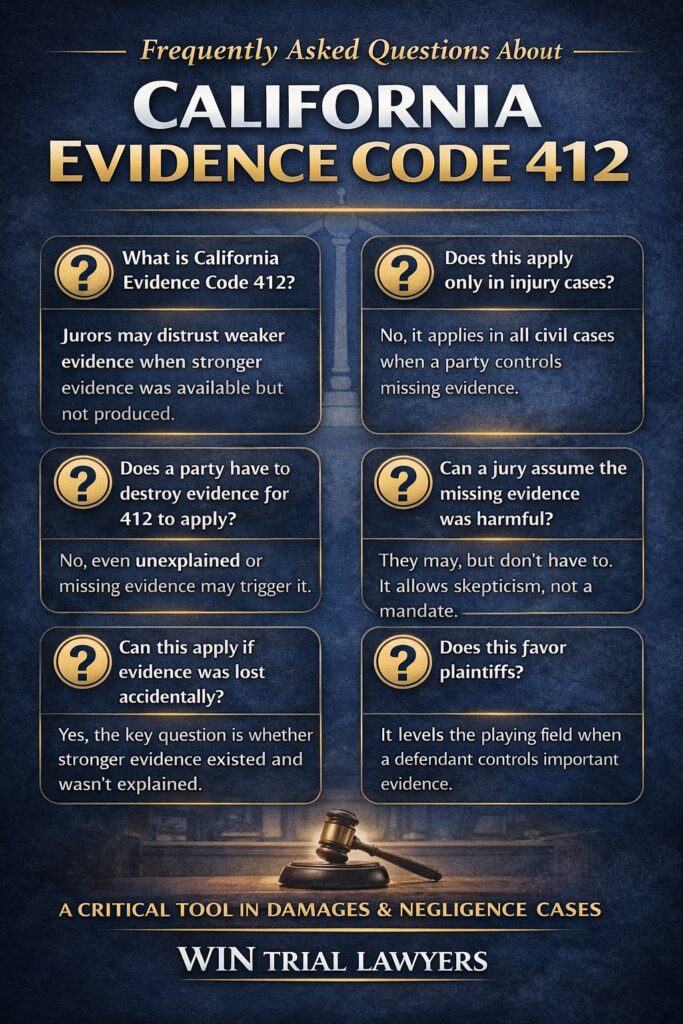
Frequently Asked Questions About California Evidence Code 412
What is California Evidence Code 412?
Evidence Code 412 allows jurors to distrust weaker evidence when a party had the ability to produce stronger, more complete evidence but failed to do so.
What does “failure to explain evidence” mean?
It means a party:
- Did not produce evidence they reasonably could have
- Offered partial or inferior substitutes instead
- Failed to explain why important evidence is missing
Jurors are allowed to question credibility when this happens.
Does Evidence Code 412 apply only in personal injury cases?
No. It applies to all civil cases, but it is especially impactful in personal injury, wrongful death, and product liability cases where defendants often control key evidence.
Does a party have to destroy evidence for § 412 to apply?
No. Unlike spoliation, intentional destruction is not required. The statute applies even when evidence is missing, incomplete, or unexplained.
Can a jury assume the missing evidence would have been harmful?
Jurors are permitted to consider that possibility, but they are not required to. The statute allows skepticism, not an automatic finding.
Is Evidence Code 412 the same as spoliation?
No. They are related but different.
- Evidence Code 412 → credibility and weight of evidence
- Spoliation → destruction or alteration of evidence and possible sanctions
§ 412 can apply even when no spoliation motion is filed.
Who decides whether Evidence Code 412 applies?
Ultimately, the jury decides how much weight to give missing or weaker evidence, guided by the judge’s instructions.
Can this statute apply if evidence was lost accidentally?
Yes. Accidental loss does not prevent § 412 from applying if the party cannot adequately explain why stronger evidence was unavailable.
What types of evidence commonly trigger Evidence Code 412?
Common examples include:
- Missing surveillance or dashcam footage
- Lost black-box or electronic data
- Incomplete medical records
- Missing maintenance or safety logs
- Failure to call key witnesses under a party’s control
Does this statute favor plaintiffs?
It helps level the playing field, especially when defendants control information and records that injured plaintiffs cannot access on their own.
Can Evidence Code 412 be argued during closing arguments?
Yes. It is frequently used in closing argument to highlight credibility issues and explain why the jury should distrust incomplete evidence.
Does a judge have to give a specific jury instruction for § 412?
Judges may incorporate the principle into general evidence and credibility instructions, depending on the case and how the evidence was presented.
What if a defendant claims the evidence never existed?
Jurors may evaluate:
- Whether that explanation is reasonable
- Whether similar evidence normally exists
- Whether the party had exclusive control
If the explanation is weak, § 412 becomes more persuasive.
Can Evidence Code 412 apply to missing witnesses?
Yes. If a party fails to call a key witness under their control, jurors may question why that testimony was not presented.
Does § 412 shift the burden of proof?
No. The plaintiff still bears the burden of proof. § 412 affects how evidence is evaluated, not who must prove the case.
How does this statute help jurors?
It gives jurors permission to use common sense when evidence seems incomplete or selectively presented.
Can Evidence Code 412 apply to digital evidence?
Absolutely. It is frequently invoked with:
- Video footage
- Electronic logs
- Metadata
- Emails, texts, or internal systems
Digital gaps often raise serious credibility concerns.
What role does Evidence Code 412 play in trial strategy?
It influences:
- Discovery strategy
- Deposition questioning
- Motions in limine
- Trial themes
- Closing arguments
Missing evidence becomes part of the story.
Can a party avoid § 412 by producing some evidence?
Not necessarily. Producing weaker or partial evidence instead of stronger available evidence can actually trigger § 412.
Does Evidence Code 412 require expert testimony?
No. It relies on logical inference, not expert analysis, although experts may explain why stronger evidence should exist.
Why is Evidence Code 412 important in jury trials?
Because juries care deeply about fairness and transparency. When evidence is missing, jurors want to know why.
How does WIN Trial Lawyers use Evidence Code 412?
WIN uses § 412 to:
- Highlight missing evidence early
- Expose credibility gaps
- Challenge defense narratives
- Frame powerful jury arguments
When defendants fail to explain missing proof, we make sure jurors notice.