
Buses move millions of Californians every year—whether through public transit systems, private shuttles, charter services, or school districts. But when a bus accident happens, the results can be catastrophic. Because buses carry so many passengers and share the road with cars, trucks, and pedestrians, even a single crash can leave multiple people injured or worse.
One of the most important questions after a bus accident is: who can be sued? Unlike a simple car accident, liability in a bus crash can involve multiple parties. At WIN Trial Lawyers, we hold negligent companies, drivers, and public entities accountable so victims get the justice they deserve.
Common Causes of Bus Accidents
Bus accidents can occur in a wide range of circumstances, and because buses carry dozens of passengers and operate in busy urban areas, even a momentary lapse in judgment can have devastating consequences. Understanding the cause of the crash is critical because it determines who is legally responsible and what types of claims an injured passenger, pedestrian, or driver can pursue.
Some of the most common causes include:
• Driver Negligence
Bus drivers are responsible for safely operating large, heavy vehicles with limited visibility and long stopping distances. When a driver engages in careless behavior—such as speeding, texting while driving, driving while fatigued, or operating the bus under the influence of alcohol or drugs—the risk of a catastrophic collision increases significantly. Fatigue is especially common among drivers working long shifts or split schedules.
• Poor Vehicle Maintenance
Buses require regular inspections and careful maintenance. When bus companies or public transit agencies fail to maintain brakes, steering systems, tires, lights, suspension components, or safety equipment, mechanical failure can lead to loss of control. Worn brakes, tire blowouts, or engine malfunctions often point to negligence by the bus operator, maintenance contractor, or fleet manager.
• Overloaded Buses or Improper Weight Distribution
Bus operators must follow strict weight-limit guidelines. When buses are overcrowded, or cargo and equipment are improperly secured, the added weight can affect the bus’s ability to steer, brake, or make emergency maneuvers. Overloading also increases rollover risks and can make injuries far more serious during a sudden stop or collision.
• Unsafe Road Conditions or Poor Traffic Control
Hazardous roadways—such as those with potholes, faded lane markings, malfunctioning traffic lights, missing signage, or construction zones lacking adequate warnings—can contribute to serious crashes. In these cases, government entities or contractors responsible for road design and maintenance may share liability.
• Negligent Third-Party Drivers
Other motorists often cause bus accidents. A distracted or speeding driver may sideswipe a bus, run a red light, or make an unsafe lane change, forcing the bus operator into a collision. In these situations, the at-fault driver and their insurance company may be liable for injuries suffered by bus passengers or other victims.
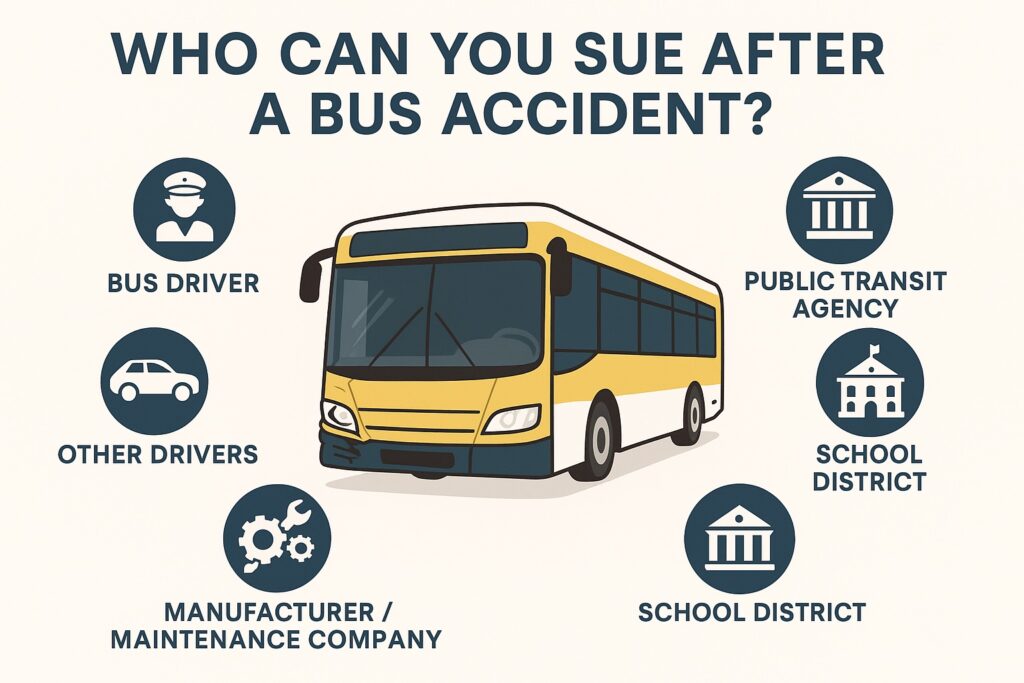
Who Can Be Sued After a Bus Accident in California?
Determining liability in a bus accident is often far more complex than in a standard car crash. Multiple parties may share responsibility, and identifying every negligent party is crucial to maximizing your recovery. Below are the primary defendants who may be held liable depending on the circumstances.
1. The Bus Driver
If the bus driver engaged in negligent or unsafe behavior, they can be held personally responsible for causing the crash. Examples include:
- Running a red light or stop sign
- Speeding or making unsafe turns
- Texting, eating, or using a phone while driving
- Driving while fatigued
- Operating the bus under the influence of alcohol or drugs
While drivers are often covered by their employer’s insurance, they can still be named individually in the lawsuit. Their negligence also triggers liability for other defendants, including the bus company or public transit agency.
2. The Bus Company (Private Operators)
Private bus companies—including charter bus services, tour bus operators, airport shuttle companies, and intercity bus providers—are typically liable for the actions of their employees under California’s respondeat superior rule. Beyond vicarious liability, the company may also be sued for its own independent negligence, such as:
- Negligent hiring, including failing to vet driving records or prior DUIs
- Insufficient training, especially for drivers operating large commercial vehicles
- Unreasonable scheduling, forcing drivers to work long, unsafe shifts that lead to fatigue
- Poor maintenance practices, leading to brake failures, tire blowouts, or engine issues
- Failure to enforce safety policies
Bus companies have a duty to keep passengers safe. When they cut corners to save money, serious injuries follow.
3. Public Transit Agencies
If the crash involves a city or county transit system—such as LA Metro, AC Transit, SF Muni, OCTA, or any other public bus service—victims may have a claim against the government entity responsible for operating the fleet.
However, suing a government agency requires following strict procedures under the California Government Claims Act:
- You must file a government tort claim within 6 months of the accident.
- The agency has a short window to accept or reject your claim.
- Only after this step can you file a civil lawsuit.
Failing to meet these deadlines can permanently destroy your right to compensation, which is why victims should speak with an attorney immediately.
4. School Districts
School bus accidents often involve complex liability because school districts, bus contractors, and individual drivers may all share responsibility. You may have claims against:
- The school district itself
- A contracted transportation company
- The driver
- A maintenance provider
Like transit agency claims, lawsuits against school districts also require filing a government claim within 6 months, so acting quickly is critical. These cases often involve high stakes because they typically affect minors.
5. Other Negligent Drivers
Not all bus crashes are caused by the bus operator. Another motorist may:
- Sideswipe or rear-end a bus
- Run a red light into the bus’s path
- Make an unsafe lane change
- Drive under the influence
- Fail to yield during a left turn
In these scenarios, you can file a claim against the at-fault driver and their insurance policy. In multi-vehicle collisions, several drivers may share fault, making a full investigation essential.
6. Manufacturers and Maintenance Companies
Sometimes the crash occurs because the bus itself was unsafe. Third parties may be liable when:
- Defective parts (brakes, steering components, tires, electrical systems) fail
- Design defects make the bus inherently unstable
- Faulty repairs or negligent service work cause mechanical failure
- Poor workmanship from a maintenance contractor leads to dangerous conditions
Product liability and negligent maintenance claims can dramatically increase available compensation, especially when multiple victims are injured.
Why Identifying Every Defendant Matters
Bus accidents often involve high damages due to the number of passengers and severity of injuries. Many times, one defendant’s insurance policy is not enough to cover all losses. WIN Trial Lawyers conducts detailed investigations to identify every responsible party so we can pursue all available insurance coverage and maximize your recovery.
What Damages Can Victims Recover?
Bus accident victims may be entitled to compensation for:
- Medical expenses (current and future)
- Lost wages and loss of future earning ability
- Pain and suffering
- Emotional distress
- Permanent disability or disfigurement
- Wrongful death damages (for surviving family members)
Because bus accidents often injure multiple victims, the stakes—and settlement values—are usually much higher than in standard car accidents.
Special Challenges in Bus Accident Cases
Bus accident lawsuits are complex because:
- Multiple parties may share fault.
- Government liability rules apply in public transit cases.
- Large companies and their insurers fight aggressively to minimize payouts.
That’s why hiring a law firm with experience in catastrophic injury and public entity litigation is crucial.
What To Do After a Bus Accident
- Seek medical care immediately. Even if injuries seem minor, get evaluated.
- Report the accident. Make sure the incident is documented by police or transit authorities.
- Gather evidence. Photos, witness contacts, and details about the bus can make or break your case.
- File timely claims. Especially important if a government agency is involved (6-month deadline).
- Contact WIN Trial Lawyers. We’ll investigate the cause, identify all responsible parties, and fight for full compensation.
Why Choose WIN Trial Lawyers?
Bus accident cases aren’t simple car crash claims—they require knowledge of transportation law, public entity rules, and complex liability chains. At WIN Trial Lawyers, we have the skill, resources, and courtroom experience to take on bus companies, school districts, and government agencies.
At WIN Trial Lawyers, we have the resources and trial experience to take on trucking companies and their insurers. We fight to recover every dollar you deserve—whether through negotiation or in court.

At WIN Trial Lawyers, we know how devastating distracted driving accidents can be. Victims often face mounting medical bills, lost wages, and emotional trauma. Our team has successfully taken on insurance companies and distracted drivers, recovering millions for injured clients.
If you or a loved one has been injured in a speeding-related car accident, don’t leave your future in the hands of the insurance company. You need experienced trial lawyers who know how to prove liability and fight for maximum compensation.
If you or a loved one has been injured in a distracted driving accident, don’t face this alone. The sooner you act, the stronger your case will be.