

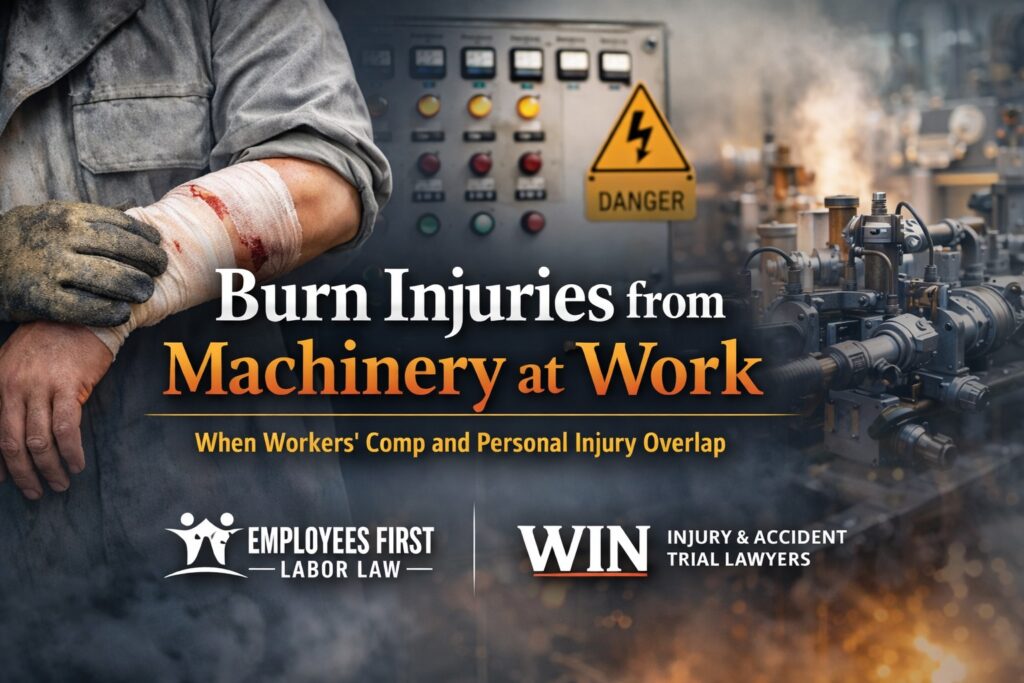
Burn injuries are among the most devastating injuries a worker can suffer. In industrial, manufacturing, and construction environments, burns often occur suddenly—when machinery overheats, sparks, leaks chemicals, or malfunctions electrically. These injuries are painful, life-altering, and frequently permanent.
What many injured workers don’t realize is this: burn injuries from machinery often involve more than just workers’ compensation.
At Employees First Labor Law (EFLL) and WIN Injury & Accident Trial Lawyers, we work together to handle both sides of these cases in-house—ensuring injured workers receive every form of compensation available, not just limited workers’ comp benefits.
How Machinery Causes Burn Injuries at Work
Industrial machinery operates under extreme conditions—high heat, high voltage, pressure, and chemical exposure. When safety systems fail, the results can be catastrophic.
Common causes of machinery-related burn injuries include:
- Overheated machinery or exposed hot surfaces
- Electrical malfunctions, arc flashes, or faulty wiring
- Chemical leaks or splashes from processing equipment
- Steam or pressurized fluid releases
- Fires or explosions caused by mechanical or electrical failure
These incidents frequently occur during routine operation, cleaning, or maintenance, when workers reasonably believe the equipment is safe.
Common Types of Machinery-Related Burn Injuries
Machinery-related burn injuries can vary widely depending on the source of heat, energy, or chemicals involved—but all share one thing in common: they are often severe, sudden, and life-altering. Below are the most common types of burn injuries we see arising from industrial and workplace machinery.
🔥 Thermal Burns
Thermal burns occur when workers come into direct contact with extreme heat or open flame generated by machinery. These are among the most common and devastating workplace burn injuries.
They are often caused by:
- Hot machinery components, such as ovens, presses, furnaces, or heated surfaces without proper guarding
- Molten materials, including metal, plastic, or other substances used in industrial processes
- Steam or heated liquids released from pressurized systems or malfunctioning equipment
- Flames from equipment fires, often triggered by mechanical or electrical failures
Severe thermal burns can destroy skin and underlying tissue, frequently requiring skin grafts, reconstructive surgery, long hospital stays, and extensive rehabilitation. Permanent scarring and disfigurement are common.
⚡ Electrical Burns
Electrical burns are especially dangerous because the most serious damage often occurs inside the body, even when external burns appear minor. Electricity can travel through tissue, damaging muscles, nerves, blood vessels, and organs.
Common causes of electrical burns include:
- Faulty wiring or control panels that expose workers to live electricity
- Defective emergency shut-offs that fail to cut power during emergencies
- Unexpected startups during maintenance or cleaning, when machines should be de-energized
- Poor grounding or insulation, allowing current to pass through equipment or workers
Electrical burns frequently occur without warning and can result in cardiac complications, nerve damage, or long-term disability.
🧪 Chemical Burns
In manufacturing, food processing, and industrial cleaning environments, machinery often handles corrosive chemicals that can cause severe chemical burns on contact.
Chemical burns commonly result from:
- Leaking hoses, valves, or tanks connected to processing equipment
- Equipment failures during wash-down or sanitation procedures
- Inadequate shielding or containment, allowing chemicals to splash or spray
- Failure to warn of chemical hazards or provide proper safety systems
Unlike other burns, chemical burns can continue to worsen until the chemical is fully neutralized, increasing the risk of deep tissue damage and infection.
💥 Burns from Fires or Explosions
Some of the most catastrophic burn injuries occur when machinery failures lead to fires or explosions. These incidents often involve massive energy releases and multiple forms of trauma.
They may involve:
- Gas-powered equipment or fuel-based systems
- Electrical arcs or sparks igniting flammable materials
- Pressurized systems rupturing, releasing heat, steam, or chemicals
Burns from fires or explosions are frequently accompanied by blast injuries, fractures, shrapnel wounds, or traumatic brain injuries, making recovery especially complex and prolonged.
Machinery-related burns are rarely minor injuries. They often leave lasting physical and emotional scars—and in many cases, they were entirely preventable. Identifying the type of burn is a critical step in determining what went wrong, who is responsible, and how an injured worker can pursue full compensation.
When Burn Injuries Are More Than a Workers’ Comp Case
Workers’ compensation is often the first and fastest source of benefits after a workplace burn injury. It typically covers:
- Necessary medical treatment
- A portion of lost wages while you are unable to work
While these benefits are important, they represent only a fraction of the true harm caused by a serious burn injury.
What workers’ compensation does not cover is often just as significant as what it does:
- Pain and suffering, including the physical agony and emotional trauma associated with burns
- Permanent scarring or disfigurement, which can affect confidence, mental health, and personal relationships
- Loss of quality of life, including limitations on daily activities and independence
- Full future earnings losses, particularly when a worker can no longer return to the same job or career
For workers with severe burns, these uncompensated losses can far exceed the benefits provided by workers’ comp.
Why Personal Injury Claims Matter in Machinery Burn Cases
Burn injuries caused by machinery frequently involve third-party liability—meaning someone other than the employer may be legally responsible. When that happens, injured workers may pursue a personal injury claim in addition to workers’ comp.
Common sources of third-party liability include:
- Defective machinery, involving unsafe design or manufacturing defects that caused overheating, electrical failure, or chemical exposure
- Failure to warn of known heat, electrical, or chemical hazards associated with the equipment
- Outside contractors or maintenance vendors who improperly serviced, installed, or modified machinery
- Unsafe third-party modifications, including removed guards, altered controls, or bypassed safety systems
Unlike workers’ compensation, personal injury claims allow injured workers to seek full compensation for the real impact of their injuries.
How Personal Injury Claims Increase Total Recovery
A successful third-party personal injury claim may allow recovery for:
- Full past and future medical expenses
- Pain and suffering
- Disfigurement and scarring
- Emotional distress and psychological trauma
- Loss of enjoyment of life
- Total future earnings and earning capacity
In serious burn cases, these damages often dramatically exceed workers’ comp benefits—sometimes by hundreds of thousands or even millions of dollars.
Why Coordination Is Critical
Pursuing both workers’ comp and personal injury claims requires careful coordination. Settling one case too early or without strategy can:
- Reduce leverage in lien negotiations
- Trigger credits against future benefits
- Limit overall recovery
That’s why burn injury cases involving machinery should never be handled in isolation.
When handled correctly, workers’ comp provides immediate support—while personal injury claims deliver the long-term financial justice burn victims deserve.
In short, burn injuries from machinery are rarely “just” a workers’ comp case. They are often complex, high-stakes matters that demand a comprehensive legal strategy to ensure injured workers receive every dollar they are entitled to recover.
Why EFLL × WIN Matters in Burn Injury Cases
Most firms handle either workers’ comp or personal injury.
EFLL × WIN handles both—together.
This means:
- No communication gaps between firms
- No conflicting settlement strategies
- Coordinated handling of workers’ comp benefits, PI claims, and liens
- Protection of future medical care
- Significantly higher net recovery for the injured worker
We routinely handle cases where burn victims recover six figures or more above workers’ comp alone because of coordinated third-party litigation.
Proving Liability in Machinery-Related Burn Cases
Machinery-related burn cases are fact-intensive and expert-driven. Determining why a machine overheated, sparked, leaked chemicals, or failed electrically requires more than surface-level investigation—it demands a coordinated, technical deep dive into the equipment, its history, and how it was designed, built, and maintained.
These cases typically require aggressive investigation and evidence development, including:
- Engineering, fire-cause, and electrical experts to identify the precise source of heat, ignition, or electrical failure and explain how the incident occurred
- Inspection of the machinery and failed components, often preserving and analyzing parts to determine whether a defect, malfunction, or improper modification caused the burn
- Review of design specifications, recalls, and prior incidents, which may reveal known hazards, similar past failures, or safer alternative designs
- Chemical and electrical analysis, particularly in cases involving arc flashes, power surges, corrosive substances, or pressurized systems
- Safety, maintenance, and service records, which can expose improper servicing, skipped inspections, or unsafe third-party work
In coordinated cases, WIN Injury & Accident Trial Lawyers leads the third-party and product liability investigation, focusing on defective equipment, failure to warn, and negligent third parties.
At the same time, Employees First Labor Law (EFLL) ensures that workers’ compensation benefits are secured, maximized, and protected, including medical care, wage replacement, and permanent disability benefits.
This dual-track approach prevents gaps, preserves evidence early, and strengthens both cases simultaneously.
Who Can Be Held Liable?
Liability in machinery-related burn cases often extends beyond a single entity. Because these injuries frequently stem from equipment failures, unsafe designs, or improper servicing, multiple parties may share responsibility.
Depending on the facts, liable parties may include:
- Machinery manufacturers, when burns result from defective design, manufacturing defects, or inadequate safety systems
- Component or electrical system manufacturers, such as those responsible for wiring, control panels, sensors, heating elements, or emergency shut-offs
- Maintenance or service contractors, whose improper repairs, inspections, or modifications created or worsened the hazard
- Third-party installers or vendors, particularly when equipment was incorrectly installed, retrofitted, or altered after purchase
Under product liability law, injured workers often do not need to prove negligence or fault. Instead, they must show that:
- The equipment was defective or unreasonably dangerous, and
- The defect was a substantial factor in causing the burn injury.
This legal standard exists because manufacturers and third parties—not workers—are in the best position to design, build, inspect, and maintain safe machinery.
When burn injuries are caused by defective or dangerous equipment, accountability is not optional. It is essential—to compensate the injured worker fully and to prevent the same machinery from injuring someone else.
Burn Injuries Change Lives — Accountability Changes Outcomes
Burn injuries often result in:
- Permanent scarring or disfigurement
- Nerve damage and chronic pain
- Loss of mobility or function
- Psychological trauma, including PTSD
- Long-term disability
These injuries are frequently preventable. Holding manufacturers and third parties accountable forces safer design, better warnings, and improved workplace safety.
Burned by Machinery at Work? Talk to EFLL × WIN.
If you suffered a burn injury from workplace machinery, do not assume workers’ comp is your only option.
At EFLL × WIN, we evaluate every angle of your case—workers’ comp, personal injury, and beyond—to maximize your recovery and protect your future
Get Help From WIN Injury & Accident Trial Lawyers
Why Legal Representation Matters
Insurance companies often undervalue pain and suffering—offering minimal settlements that ignore your daily struggles. A skilled attorney can:
- Present powerful evidence of your emotional and physical suffering
- Retain expert witnesses to quantify your losses
- Use verdict data to justify higher multipliers or per diem rates
- Argue your case persuasively before a jury
At WIN Trial Lawyers, our team fights to ensure that your recovery reflects the full extent of your suffering—not just your bills.

At WIN Trial Lawyers, we know how personal injury claims can be can be. Victims often face mounting medical bills, lost wages, and emotional trauma. Our team has successfully taken on insurance companies and third parties, recovering millions for injured clients.
If you or a loved one has been injured in an accident, don’t leave your future in the hands of the insurance company. You need experienced trial lawyers who know how to prove liability and fight for maximum compensation.
If you or a loved one has been injured, don’t face this alone. The sooner you act, the stronger your case will be.
🔗 Related Posts:
Frequently Asked Questions (FAQs): Burn Injuries from Machinery at Work
Are burn injuries from machinery covered by workers’ compensation?
Yes. Burn injuries that occur in the course and scope of employment are generally covered by workers’ compensation, including medical treatment and partial wage replacement. However, workers’ comp does not fully compensate burn victims for pain, disfigurement, or long-term life impact.
Can I sue if my burn injury was caused by defective machinery?
Often, yes. If your burn injury was caused by defective machinery, faulty components, or failure to warn, you may have a third-party personal injury claim in addition to workers’ comp. This is where significant additional compensation is often recovered.
What types of machinery commonly cause burn injuries?
Burn injuries frequently involve:
- Industrial presses and ovens
- Electrical panels and control systems
- Manufacturing and food-processing equipment
- Chemical processing or sanitation machinery
- Gas-powered or pressurized equipment
These machines often involve heat, electricity, or chemicals—making failures especially dangerous.
What if my employer says it was just an “accident”?
Burn injuries from machinery are rarely just accidents. Many involve:
- Poor machine design
- Manufacturing defects
- Missing or failed safety systems
- Inadequate warnings
- Third-party maintenance errors
Even if workers’ comp applies, responsibility may extend beyond your employer.
Do I still have a case if I was burned during cleaning or maintenance?
Yes. Many serious burn injuries occur during cleaning, maintenance, or troubleshooting, when workers reasonably believe machinery is powered down or safe. Unexpected startups, residual heat, electrical faults, or chemical exposure are common indicators of product defects or third-party liability.
Can I recover compensation for scarring or disfigurement?
Workers’ comp provides limited benefits for permanent impairment, but it does not fully compensate for scarring, disfigurement, or emotional trauma. A personal injury claim can seek damages for:
- Pain and suffering
- Disfigurement
- Emotional distress
- Loss of quality of life
What if multiple parties caused my burn injury?
That is common in machinery burn cases. Liability may extend to:
- Equipment manufacturers
- Component or electrical system manufacturers
- Maintenance or service contractors
- Third-party installers or vendors
EFLL × WIN evaluates all responsible parties, not just your employer.
How does EFLL × WIN handle burn injury cases differently?
Unlike most firms, EFLL × WIN handles workers’ comp and personal injury cases together, in-house. This means:
- No coordination breakdowns between firms
- Strategic timing of settlements
- Aggressive lien negotiation
- Protection of future medical benefits
- Higher net recovery for the injured worker
This integrated approach is critical in serious burn cases.
Can a workers’ comp settlement hurt my personal injury case?
Yes—if handled incorrectly. Settling workers’ comp too early can:
- Reduce leverage in lien negotiations
- Trigger credits against future benefits
- Undermine a third-party recovery
That’s why coordination between workers’ comp and PI counsel is essential—and why EFLL × WIN handles both together.
How long do I have to take legal action after a burn injury?
Strict deadlines apply, and they vary depending on the type of claim. Delays can result in lost evidence or barred claims. Burn injuries involving machinery should be evaluated as soon as possible to preserve your rights.
What if my burn injury requires long-term or lifetime medical care?
Severe burn injuries often require multiple surgeries, skin grafts, ongoing wound care, pain management, and psychological treatment. EFLL ensures workers’ comp provides immediate and continuing medical benefits, while WIN pursues third-party claims to recover the full cost of future care, not just what workers’ comp covers.
Can I bring a claim if the machinery was old or previously used?
Yes. Age does not excuse unsafe machinery. Older equipment often lacks modern safety features or suffers from deteriorated components. If a machine was defectively designed, improperly maintained by a third party, or failed due to manufacturing defects, liability may still exist.
What if my burn injury involved chemicals used in food processing or manufacturing?
Chemical burns frequently involve third-party liability, especially when equipment leaks, sprays, or fails during cleaning or processing. Claims may involve defective machinery, improper containment systems, or failure to warn about chemical hazards.
Will filing a personal injury claim affect my workers’ comp benefits?
No—if handled correctly. Workers’ comp and personal injury claims can proceed together. The key is strategic coordination to avoid lien issues or benefit interruptions. EFLL × WIN manages both sides to protect your benefits and maximize recovery.
What if I was wearing protective gear when I was burned?
Protective gear does not eliminate manufacturer responsibility. If machinery malfunctioned, overheated, sparked, or leaked chemicals despite proper PPE, this often supports a claim that the equipment itself was unsafe or defective.
Can burn injuries qualify for permanent disability benefits?
Yes. Severe burns frequently result in permanent disability, loss of function, scarring, or psychological trauma. EFLL fights for accurate permanent disability ratings, while WIN seeks additional compensation for life-altering harm through third-party claims.
What if OSHA investigated my burn injury?
An OSHA investigation can provide valuable evidence, but it does not replace your legal rights. OSHA findings may help prove unsafe machinery or conditions, but separate workers’ comp and personal injury claims are still critical to full recovery.
Why is early legal involvement important in burn injury cases?
Burn cases involve time-sensitive evidence, including failed machinery, electrical components, and chemical residues. Early involvement allows EFLL × WIN to preserve evidence, retain experts, and prevent insurers or manufacturers from shifting blame.
How can EFLL × WIN help after a machinery burn injury?
At Employees First Labor Law × WIN Injury & Accident Trial Lawyers, we:
- Secure workers’ comp benefits immediately
- Investigate defective machinery and third-party liability
- Work with engineering, electrical, and burn experts
- Maximize total recovery across all claims