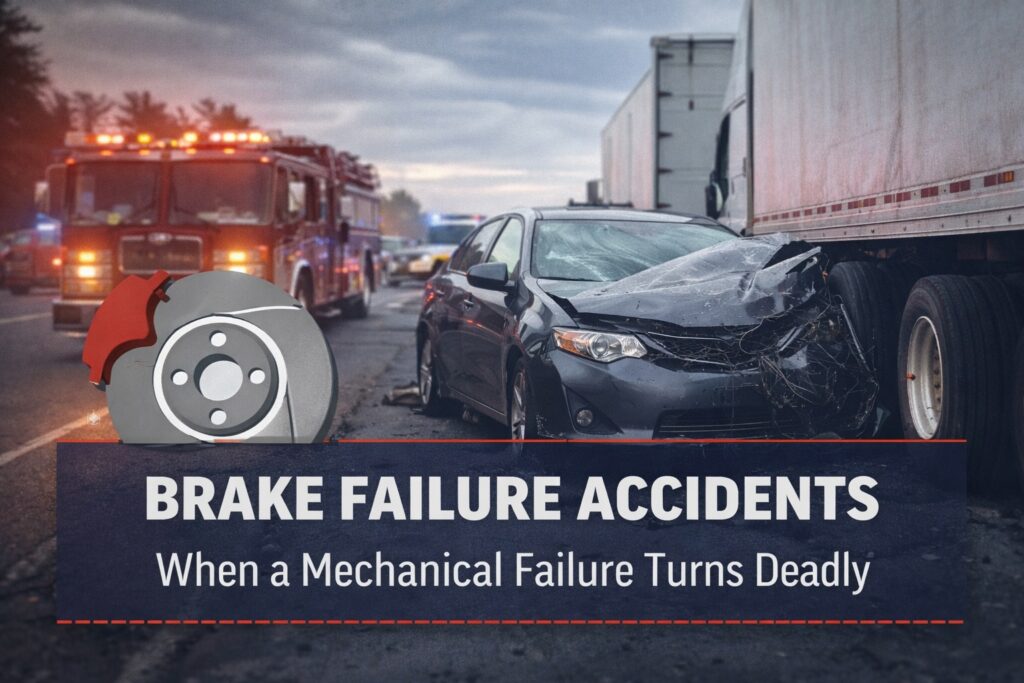
Brake failure accidents are among the most frightening and dangerous crashes on the road. When brakes fail, drivers often have no ability to slow down, stop, or avoid impact, turning everyday traffic situations into catastrophic events.
At WIN Injury & Accident Trial Lawyers, we regularly investigate serious injury and wrongful death cases caused by brake failures in both passenger vehicles and commercial trucks. These crashes are often preventable — and they frequently involve corporate or mechanical negligence, not just driver error.
What Is a Brake Failure Accident?
A brake failure accident occurs when a vehicle’s braking system does not work as intended, preventing the driver from slowing down or stopping safely. Unlike typical crashes caused by distraction or speeding, brake failure accidents often happen without warning, leaving drivers with little or no ability to avoid impact.
Brake failure may be sudden or progressive and can involve one or more critical components of the braking system. Even attentive, experienced drivers may be unable to prevent a collision once braking power is compromised.
Brake failure accidents may involve:
- Complete loss of braking power, where the pedal goes to the floor and the vehicle does not slow
- Partial braking, where brakes engage but cannot stop the vehicle in time
- Brake fade, often caused by overheating during downhill driving or heavy loads
- Mechanical malfunctions, such as failed brake lines, worn pads, or defective components
In many cases, drivers attempt emergency measures — pumping the brakes, downshifting, or using the parking brake — but physics takes over. Without effective brakes, a moving vehicle cannot stop safely.
Brake failure crashes are especially dangerous because they often result in high-speed impacts, rear-end collisions, pedestrian strikes, or multi-vehicle pileups. These accidents are frequently preventable and often trace back to poor maintenance, defective parts, or failures by manufacturers, trucking companies, or repair facilities.
Common Causes of Brake Failure
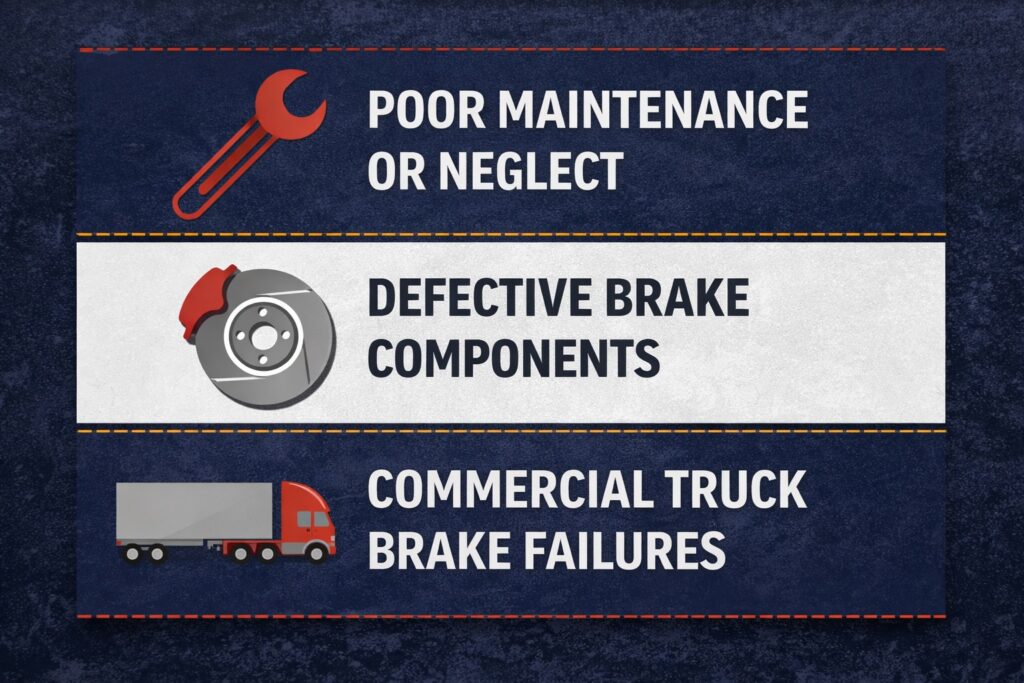
Brake failures almost never happen “out of nowhere.” In most cases, they are the result of neglect, defective parts, or improper maintenance that allowed a dangerous condition to develop over time.
Poor Maintenance or Neglect
Routine brake maintenance is critical to vehicle safety. Brake failure can occur when:
- Brake pads or rotors are excessively worn
- Brake fluid leaks reduce hydraulic pressure
- Warning lights, grinding sounds, or vibration are ignored
- Required inspections or service intervals are skipped or delayed
When maintenance is deferred, minor issues can quickly escalate into complete brake failure.
Defective Brake Components
Some brake failures stem from manufacturing or design defects, even in newer vehicles. These may include:
- Faulty brake lines or hoses that crack, rupture, or leak
- Defective master cylinders that fail to generate stopping power
- Manufacturing defects in pads, calipers, or rotors
- Recall-related defects that were never repaired or disclosed
In these cases, liability may extend beyond the driver to manufacturers or parts suppliers.
Commercial Truck Brake Failures
Brake failures are especially common — and far more dangerous — in large commercial trucks because of their size and operating conditions, including:
- Heavy or overloaded cargo
- Long downhill grades that strain braking systems
- Overheated brakes, leading to sudden brake fade
- Failure to comply with federal inspection and maintenance requirements
When truck brakes fail, the results are often catastrophic, leading to high-speed rear-end crashes, multi-vehicle pileups, or fatal collisions involving innocent motorists and pedestrians.
Who May Be Liable in a Brake Failure Accident?
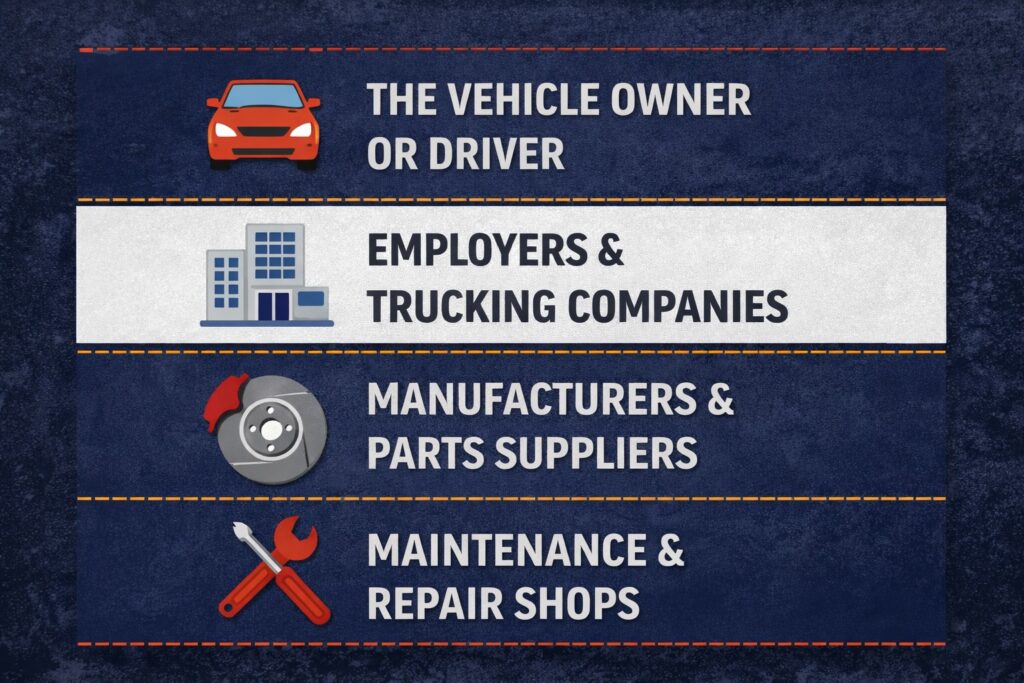
Brake failure cases are not ordinary car accident claims. Because braking systems are regulated safety components, liability often extends beyond the driver to owners, employers, manufacturers, and maintenance providers. Multiple causes of action frequently apply simultaneously.
The Vehicle Owner or Driver
Potential Causes of Action
- Negligence
- Negligence per se (where statutory violations apply)
Basis for Liability
A driver or vehicle owner may be liable if they:
- Ignored warning signs such as brake lights, grinding, squealing, or loss of pedal pressure
- Failed to maintain brakes in a reasonably safe condition
- Continued operating a vehicle they knew or should have known was unsafe
Under California law, drivers and owners have a duty to operate and maintain vehicles in a manner that does not endanger others.
Relevant Law
- California Vehicle Code § 24002 – Prohibits operating an unsafe vehicle
- California Vehicle Code § 26453 – Requires vehicles to be equipped with adequate brakes
- California Civil Code § 1714(a) – General duty of reasonable care
Violation of these statutes may support negligence per se, shifting the burden to the defendant to excuse the violation.
Employers & Trucking Companies (Commercial Vehicles)
Potential Causes of Action
- Negligence
- Negligent hiring, training, supervision, or retention
- Vicarious liability (respondeat superior)
- Negligence per se
- Wrongful death (where applicable)
Basis for Liability
For commercial vehicles, employers and trucking companies often bear direct and non-delegable responsibility. Liability may arise from:
- Failure to inspect, repair, or maintain braking systems
- Skipping required pre-trip and periodic inspections
- Pressuring drivers to operate vehicles despite known brake issues
- Allowing vehicles to remain in service in violation of safety standards
Importantly, trucking companies cannot shift responsibility to drivers when company policies, maintenance failures, or cost-cutting decisions contribute to brake failure.
Relevant Law
- 49 C.F.R. § 396.3 – Mandatory inspection, repair, and maintenance of commercial vehicles
- 49 C.F.R. § 396.11 & § 396.13 – Driver vehicle inspection reports and pre-trip inspections
- California Vehicle Code § 34501.12 – Carrier safety compliance
- California Labor Code § 2802 (often relevant to employer control and responsibility)
These duties are considered non-delegable, meaning the company remains liable even if maintenance was outsourced.
Manufacturers & Parts Suppliers
Potential Causes of Action
- Strict products liability (design defect, manufacturing defect, failure to warn)
- Negligence
- Breach of warranty
Basis for Liability
Manufacturers and suppliers may be liable if:
- Brake components were defectively designed (unsafe even when used as intended)
- Parts suffered from manufacturing defects
- The manufacturer failed to warn of known risks or limitations
- A recall defect was inadequately disclosed or remedied
Unlike negligence claims, strict liability does not require proof of fault — only that the defective product was a substantial factor in causing harm.
Relevant Law
- California strict products liability doctrine (Greenman v. Yuba Power Products, Inc.)
- California Civil Code §§ 1790–1795.8 (Song-Beverly Consumer Warranty Act, where applicable)
These cases frequently involve passenger vehicles, commercial trucks, buses, and heavy equipment.
🔧 Maintenance & Repair Shops
Potential Causes of Action
- Negligence
- Professional negligence
- Negligent misrepresentation
Basis for Liability
Repair shops and mechanics may be liable if they:
- Performed negligent or incomplete brake repairs
- Failed to identify visibly worn or unsafe brake components
- Improperly installed brake parts
- Certified a vehicle as roadworthy when it was not
Once a mechanic undertakes a repair or inspection, they assume a duty to perform services consistent with industry standards.
Relevant Law
- California Civil Code § 1714(a) – Duty of reasonable care
- Common law professional negligence standards
Shops cannot escape liability by claiming the failure occurred later if the defect was discoverable at the time of service.
Why Identifying All Liable Parties Matters
Brake failure cases often involve layered liability:
- One party caused the defect
- Another failed to detect it
- Another allowed the vehicle on the road
Each liable party may carry separate insurance coverage, which is critical in serious injury and wrongful death cases. A thorough investigation ensures:
- Full accountability
- Maximum financial recovery
- Prevention of future brake-related tragedies
How Brake Failure Is Proven in an Injury Case
Brake failure claims require immediate investigation. Critical evidence may include:
- Vehicle inspection and teardown
- Maintenance and service records
- Recall notices
- Black box / electronic data
- Expert mechanical analysis
Insurance companies often try to blame the driver — even when mechanical failure is the real cause.
What to Do After a Suspected Brake Failure Accident
If you are involved in a crash where brake failure may be involved:
- Seek medical attention immediately
- Do not repair or dispose of the vehicle
- Document any brake warning signs or prior repairs
- Speak with an attorney experienced in mechanical failure cases
Preserving the vehicle is often the key to proving your case.
How WIN Injury & Accident Trial Lawyers Can Help
Brake failure cases require a law firm that understands:
- Vehicle systems and defect litigation
- Commercial vehicle regulations
- How to fight manufacturers and trucking insurers
At WIN Injury & Accident Trial Lawyers, we work with engineers, accident reconstructionists, and industry experts to uncover the truth.
We handle these cases on a contingency basis — no fees unless we win.
Speak With a California Brake Failure Accident Lawyer
If you or a loved one was seriously injured or killed due to brake failure, you may have a claim far beyond a typical accident case.
📞 Call WIN Injury & Accident Trial Lawyers today
📍 Serving Los Angeles, Inland Empire, and statewide California
⚖️ Free consultation | No fee unless we win
Get Help From WIN Injury & Accident Trial Lawyers
Why Legal Representation Matters
Insurance companies often undervalue pain and suffering—offering minimal settlements that ignore your daily struggles. A skilled attorney can:
- Present powerful evidence of your emotional and physical suffering
- Retain expert witnesses to quantify your losses
- Use verdict data to justify higher multipliers or per diem rates
- Argue your case persuasively before a jury
At WIN Trial Lawyers, our team fights to ensure that your recovery reflects the full extent of your suffering—not just your bills.

At WIN Trial Lawyers, we know how personal injury claims can be can be. Victims often face mounting medical bills, lost wages, and emotional trauma. Our team has successfully taken on insurance companies and third parties, recovering millions for injured clients.
If you or a loved one has been injured in an accident, don’t leave your future in the hands of the insurance company. You need experienced trial lawyers who know how to prove liability and fight for maximum compensation.
If you or a loved one has been injured, don’t face this alone. The sooner you act, the stronger your case will be.